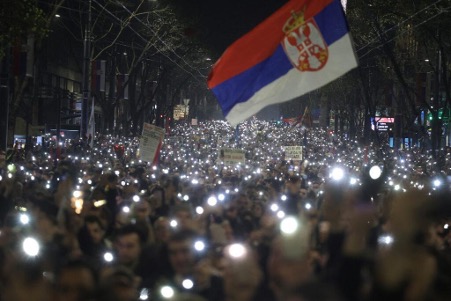
Six months after the collapse of a railway station canopy, which killed 16 people, Serbia witnessed the largest protest in its modern history. Led by students, between 275,000 and 325,000 people gathered on the streets of its capital Belgrade on March 15th, 2025, demanding justice for the victims and the fulfillment of student demands.
Today, over a year after the tragedy, what began as a student-led call for transparency has evolved from mass street blockades to a ‘campaign mode’, with students collecting over 400,000 signatures to field their own independent electoral list. These protests, far from politically orchestrated, have proven a clear example of democratic civil resistance, a movement grounded in values, not parties.
Lack of state response to tragedy sparks mass protests
On 1 November 2024, a newly renovated canopy at the Novi Sad railway station collapsed, resulting in the tragic loss of 16 lives. The government’s initial response, limited to condolences and vague promises, sparked public outrage. Citizens began holding daily 15-minute silent tributes at 11:52am, the time of the collapse.
Tensions escalated when students and professors were attacked during a tribute at the Faculty of Dramatic Arts. The government downplayed the violence, further eroding trust. This moment marked a turning point. Students began organising silent blockades and occupying faculties, actions that continue to this day.
On 29 November 2024, students formally issued a list of demands:
- Full disclosure of all documentation related to the Novi Sad station reconstruction
- Accountability for the attacks on students and professors
- Dropping charges against arrested protestors
- A 20 per cent increase in the national education budget
These four demands would become the foundation of everything that followed – a blueprint for accountability that the government would struggle to ignore, dismiss or co-opt. What made these demands particularly powerful was their precision: they were not abstract calls for change, but concrete, measurable actions that could be verified and tracked. The students had learned a crucial lesson from previous movements: vague demands allow for vague responses.
With their manifesto shared in public, the question became how the establishment would respond to this direct challenge to its authority.
Civic, not just ‘peaceful’
Civil disobedience is widely accepted as a form of democratic resistance against undemocratically adopted/imposed measures or actions. Movements like Black Lives Matter or Fridays for Future were all born out of civil disobedience and have impacted decision-making processes and public discourse.
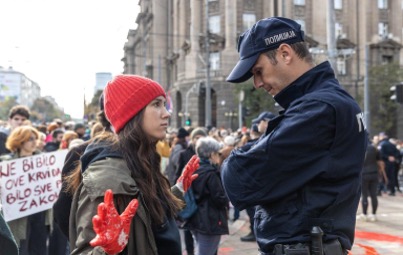
Despite these legal protections, civic movements in Serbia have often faced challenges, including physical attacks and negative media portrayal. Although immediately labelled as an attempted coup d’état or ‘colour revolution’ by pro-government media, the student protests in Serbia have been completely peaceful. They follow a clear ethical line, what philosopher John Rawls calls civil disobedience: public – mass organised rallies, nonviolent – even when targeted by opposition groups, conscientious – motivated by justice, transparency and accountability, and political but not partisan – aimed at transforming institutional dysfunction.
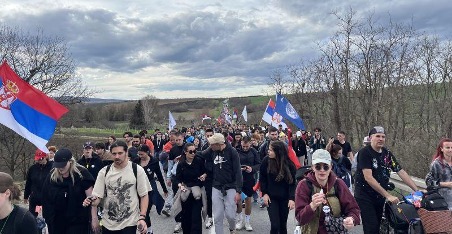
Government reaction predictable
Over the past 14 years, since Aleksandar Vučić became a dominant political figure in Serbia, the establishment has developed predictable responses to social disobedience, relying on a combination of dismissal, intimidation and media control.
Numerous attacks on students occurred, often carried out, as evidence would later show, by individuals closely associated with the ruling party.
Despite constitutional protections for peaceful protest (article 54) and free expression (article 46), students have faced repeated attacks:
- state-controlled media labelled students ‘terrorists’ and ‘Nazis’;
- a counter-camp, ‘Ćaciland’, was set up by government supporters near the National Assembly to fabricate division among students; it was dismantled in December 2025;
- rectors of multiple universities have faced pressure to discipline protesting students, and some student representatives report being secretly monitored or threatened with expulsion;
- since November 2024, more than 900 people has been detained in relation to the protest.
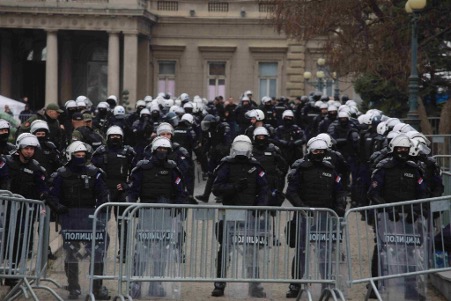
Last March, during the massive Belgrade protest, hundreds of police officers were deployed, and witnesses described what sounded like a sonic weapon, an ear-splitting noise that caused disorientation and panic. The government denied this, inviting both the FBI and Russia’s FSB to investigate; Russia later claimed no such weapon was used, but the story made international headlines.
Even the April 2025 resignation of Prime Minister Miloš Vučević and his replacement by Đuro Macut failed to quell the movement. To the students, a change of faces in the Cabinet is meaningless without a change in the culture of accountability.
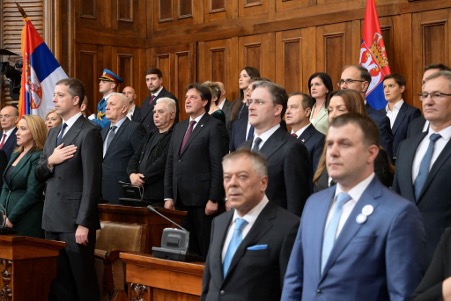
Instead of dealing with the core problem, the administration doubled down on repression. Students were detained under vague accusations like ‘inciting panic’ or ‘threatening the constitutional order’. This was particularly transparent in Novi Sad, where extended detentions felt less like justice and more like intimidation. This pattern of escalation peaked following the June 28 Belgrade protests, when hundreds of people were arrested for clashing with riot police.
Rather than extinguishing the movement, the government’s heavy-handed response has only fuelled public outrage, pouring gasoline on a fire that was already burning.
Solidarity in face of institutional violence
The most significant outcome of the student protest is the ripple effect it has caused. What started as a student protest has transformed into a broader civic movement. Teachers, lawyers and health workers have joined in solidarity. In cities across Serbia, residents have provided students with shelter, food and legal aid.
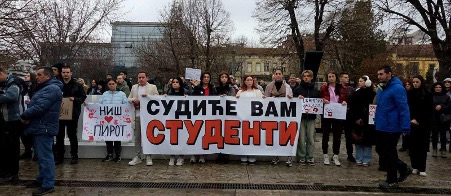
This growing wave of solidarity and civic engagement is, in itself, a form of change. Today one truth has become undeniable: a new political consciousness has taken root in Serbia. For over 15 months, without the backing of traditional political parties, this movement has maintained a momentum that seasoned political actors previously were not able to do.
The sentiment has evolved from a cautious hope into a grounded sense of civic agency. Ordinary citizens have moved from the ‘silence’ of the 11:52 am tributes to the ‘action’ of collecting over 400,000 signatures for an independent political path. These young people have achieved something far more permanent than a policy change: they have dismantled the myth that apathy is the natural state of the Serbian youth.
Regardless of the eventual electoral outcome (when it happens), the ‘us versus them’ politics of the past decade is being replaced by a value-driven resistance that has shown it can not only challenge power structures but actively begin to reshape them.
Looking ahead
Serbia’s student-led protests have been characterised as historic and a shining light in the fight for democracy on one side, and as colour revolution and coup d’état on the other side. This narrative well reflects the mantra of the ongoing regime in Serbia for the past 13 years, which has constantly maintained an ‘us versus them’ status, hiding behind national flag, diminishing any kind of challenge to them by declaring it an attack on the country itself.
Students showed immunity to such an approach and united in their demands for more transparent and just governance. Citizens of the country, no matter their age, religion or where they live, are standing behind them, giving them legitimacy and protection.
Some shifts are already visible: the resignation of the previous government, reduced tuition fees and growing public dialogue about government accountability. More fundamental changes – such as a culture of political responsibility, stronger institutions, and long-term reforms in education and justice – will take time and sustained pressure.
In time, I believe that we will conclude that the true measure of the protest has not been an political shift or change of government, but the fact that students have disrupted the assumption that apathy defines young people and that the current administration’s ‘us versus them’ politics of the current administration will no longer have a stronghold.
Serbia still stands at a crossroads and while the future remains uncertain, the path forward has been irrevocably altered by those who chose to stand strong in silence – and in resistance – at 11:52 am.
This week we are delighted to publish the second post by Marko Matović, the blog’s regional correspondent for South East Europe. His first post is available here.
The GCHRP Editorial Team