
How can we protect the Venetian Lagoon while safeguarding the rights of the people and communities who depend on it?
Organised by students and staff of the European Master’s Programme in Human Rights and Democratisation (EMA GC Europe), with the support of the German Federal Ministry for Economic Cooperation and Development (BMZ), the Festival brings together local experiences and international perspectives, placing the rights of the Venetian Lagoon and the communities that inhabit it at the centre of the programme.
The lagoon is a living ecosystem, shaped over centuries by the interaction between nature and human activity. Its extraordinary ecological value, cultural heritage and history make it a unique environment, where the protection of nature is deeply intertwined with the rights and livelihoods of the people who live there. Today, however, this balance faces growing challenges, from climate change and environmental degradation to the pressures of mass tourism and urban development.
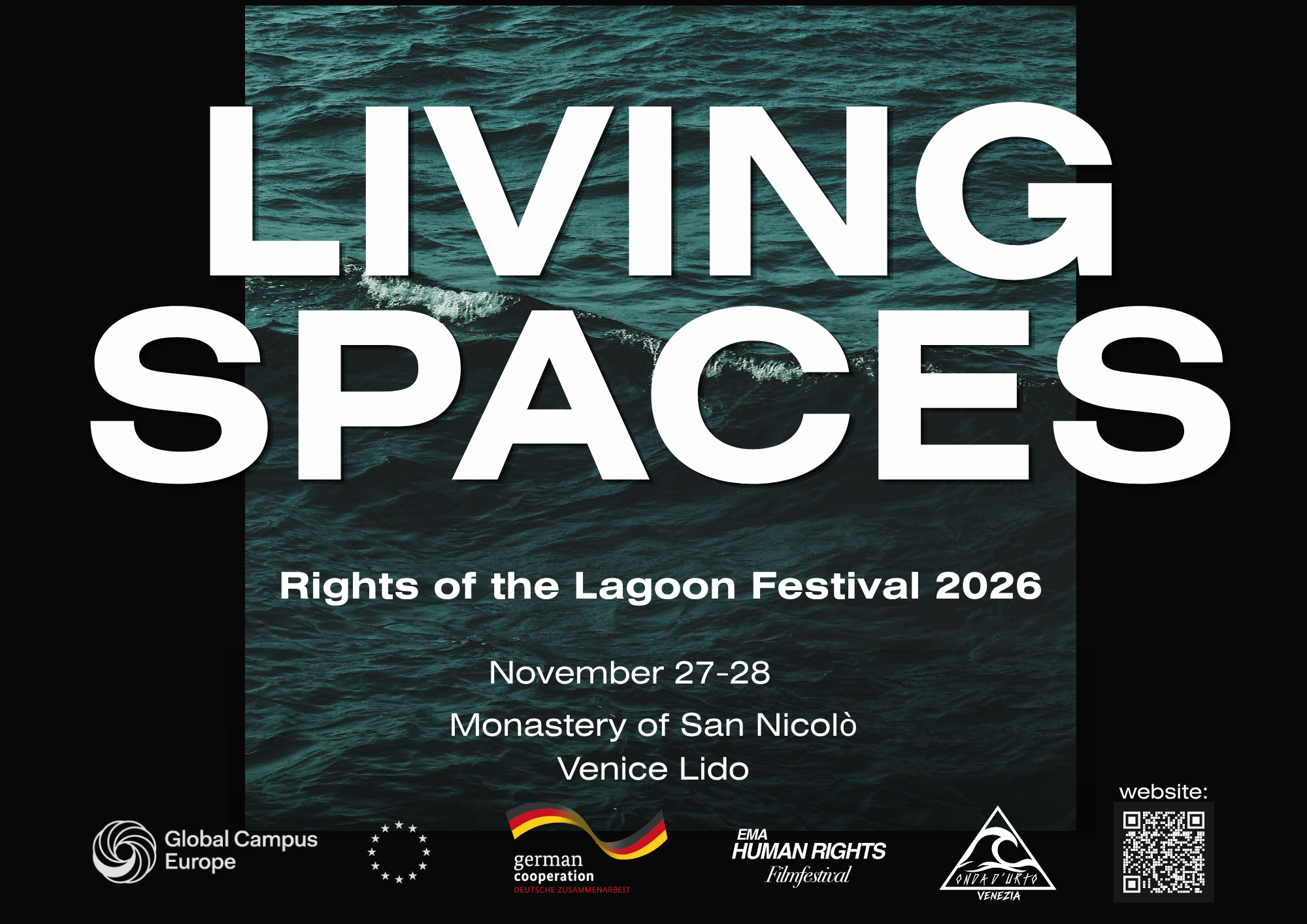
Against this backdrop, Living Spaces, the first edition of the Rights of the Lagoon Festival, invites participants to explore the relationship between the environment, human rights and the creatures and communities that inhabit the lagoon. By bringing together local initiatives, international organisations, researchers, students and artists, the Festival aims to connect local experiences with international discussions on environmental rights and the future of natural ecosystems.
TWO DAYS OF DISCUSSION, CINEMA AND ART
Friday, 27 November | 9:30–20:00
The first day will focus on the relationship between human rights, environmental protection and the Venetian Lagoon, bringing together local perspectives and international experiences.
The morning and afternoon sessions will feature Dr Heiner Krelling, Dr Silvia Sivo and Dr Mattia Favaretto from the Initiative for the Rights of the Venetian Lagoon, alongside Jane da Mosto from We are Here Venice. Francesca Santoro from UNESCO’s Regional Bureau for Science and Culture in Europe, Dr Silvia Francescon from NICHE and Stella Bongiorno from GARN will explore different approaches to environmental protection, with a particular focus on international advocacy. Angelo Camufingo from ACCR will address how environmental rights can be translated into concrete action at the local level.
The programme will also include a running experience in the Oasi di San Nicolò, offering participants an opportunity to discover the lagoon’s biodiversity firsthand.
The evening will continue with a screening of Welcome Venice (2021), directed by Andrea Segre. The film portrays the conflict between two brothers from a Venetian fishing family, torn between the desire to preserve the lagoon’s traditional way of life and the opportunities offered by the city’s growing real estate and tourism market. Their contrasting visions of Venice’s future reflect the transformations and vulnerabilities of a city increasingly exposed to the dynamics of globalisation.
The day will conclude with a live performance by Onda D’Urto, a Venetian rock band whose sound draws on punk, ska and blues.
Saturday, 28 November | 14:30–19:25
The second day will feature a programme combining cinema, creative activities and discussions on environmental and human rights issues.
Among the screenings is Mar Menor: A Film for the Frontier of Hope, a short documentary directed by Thomas Cristofoletti and part of the RESTORE series, developed as part of the United Nations Decade on Ecosystem Restoration.
The programme will also explore the links between business and human rights, with a discussion featuring Prof. Fabrizio Marrella from Ca’ Foscari University. An interactive art workshop will invite participants to connect with the voice and life of the lagoon through collaborative artworks and personal reflections, while a further creative workshop will be dedicated to children.
Cinema will once again take centre stage with Venice, The Whole Story, a series of two medium-length documentaries directed by Andrea Vogt and Paul Russell, followed by a conversation with the director.
The programme will also include a conversation with women from the lagoon on sustainable and socially equitable economies, accompanied by a photographic exhibition organised by EMA’s Feminist Club. Among the contributors is Michela Bortolozzi, a Venice-based designer and member of the Women of the Lagoon Panel, who will reflect on the city’s transformations and vulnerabilities in the face of increasingly aggressive tourism pressures.
The Festival will conclude with a debate led by EMA students, exploring the effects of climate change on local communities around the world, followed by a closing ceremony.
VENICE AND THE RIGHTS OF ITS LAGOON
Beyond its internationally recognised landscape, the Venetian Lagoon is a living environment, a source of livelihoods, cultural identity and collective memory. Its future raises fundamental questions about the relationship between human rights, environmental responsibility and the protection of natural ecosystems.
Through cinema, the arts and dialogue, Living Spaces aims to create a space for exchange between local experiences and international perspectives, encouraging a broader reflection on how to protect the lagoon while respecting the rights and aspirations of the communities that call it home.
INFORMATION
Dates: 27–28 November 2026
Venue: Monastery of San Nicolò, Global Campus of Human Rights, Riviera San Nicolò 26, Lido di Venezia, Italy.
Participation: By invitation only. Registration is required for each session.
Programme and registration: https://sites.google.com/view/emahumanrightsfilmfestival/programme
PRESS OFFICE
Isotta Esposito
Elisa Aquino
+39 041 2720911