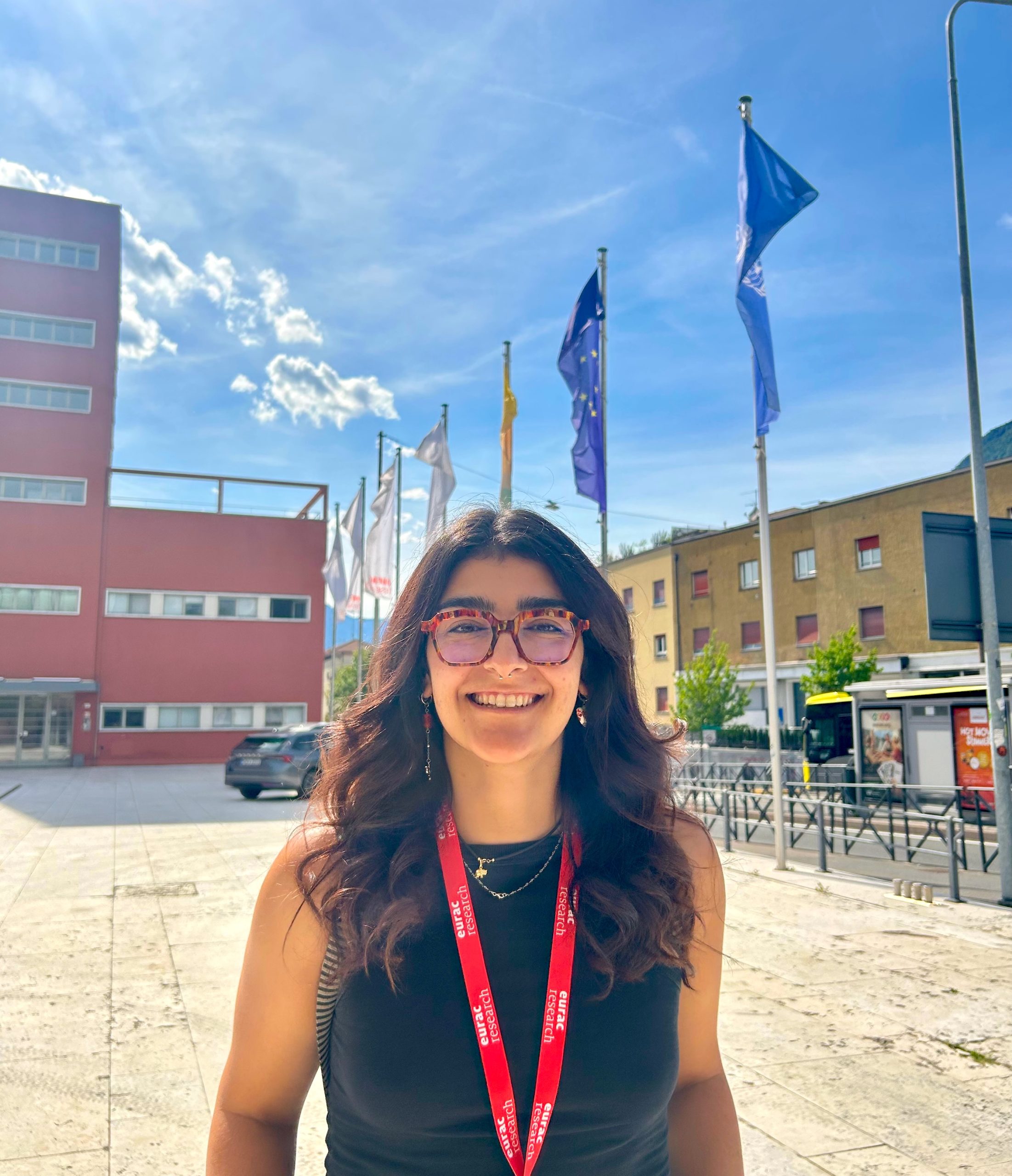
Eugenia Ricciotti is a current student in the Master of Arts in Human Rights and Sustainability (MAHRS) at the Global Campus Central Asia, but up until one year ago, Central Asia was definitely not on her radar. Born and raised in Italy, she has spent much of the last decade moving between cities and countries for her studies and professional opportunities. Her path, however, was not always pointing towards human rights research.
After completing her first master’s degree in law, she worked for an NGO first and an international organisation later on. It was during these times that she realised how much she still wanted to learn about human rights mechanisms. The decision to return to university followed, but how does an Italian end up studying human rights in Kyrgyzstan? It is, she says, the question she has been asked most often over the past year.
“I was familiar with the Global Campus and I knew it offered the kind of international environment I was looking for. However, I was not familiar with all of the programmes. When I found out about the MAHRS Programme in Bishkek, with its focus on both human rights and sustainability, I knew I had to apply.”
Moving to a region she had never visited before, without speaking the language, was certainly a challenge, but not one she was going to let stop her:
“The beginning was not easy. Arriving in Bishkek, everything felt overwhelming, from the new academic environment to life in an unfamiliar region. Yet, little by little, the city and the country began to feel less foreign.”
What started as an intimidating move eventually became an experience she did not want to end. This is why, after spending some time away, she is now back in Kyrgyzstan. Before returning to Bishkek, however, there was an important stop in Italy. Through the MAHRS Programme, she spent the summer in Bolzano working at Eurac Research, an institution she had known and admired long before joining the Programme. When writing her thesis on transnational minorities in Europe, its papers and policy documents had made up a significant part of her bibliography. The opportunity to work there therefore felt particularly meaningful.
“I felt like something coming full circle, like I was meant to go there.”
The connection between the OSCE Academy and Eurac Research made that opportunity possible. When she learned about their ongoing partnership and discovered that a Eurac Research Senior Researcher would be teaching the Minority Rights course, she knew she wanted to make the most of it.
The experience opened the door to something she had not initially expected: writing for Eurac Research. Through the Minority Rights course, she published her first blog post with the research center, focusing on Indigenous rights in the Democratic Republic of the Congo. Later, during her internship at the Institute for Comparative Federalism, she published her first blog post in Italian, exploring the debate on autonomy in Italy’s special-statute regions.
Now back in Bishkek, she is preparing to complete her coursework and continue her research on climate-induced mobility and marginalised minorities in Kyrgyzstan, with the support of her supervisor from Eurac Research.
From a law degree in Italy to human rights studies in Central Asia, and from reading Eurac Research publications to contributing to them, her MAHRS experience has brought together academic interests, professional opportunities and a region that has gradually become a second home.