
Photo credit: PaRD/GIZ
That realisation led him to the Master’s Programme in Human Rights and Democratisation in Asia Pacific (APMA – GC Asia Pacific), hosted at the Institute of Human Rights and Peace Studies, Mahidol University. For Ven. Napan, APMA provides a language and framework that complements religious teachings. “Peace and human rights are two sides of the same coin,” he reflects, drawing on his experience supporting communities affected by violence and fear. Learning about international standards and mechanisms has enabled him to move beyond moral persuasion towards structural change — equipping him to engage policy-makers, educators and religious leaders alike.
His journey to APMA grew directly from practical work on the ground. After collaborating with Thailand’s Human Rights Commission on a project training “healer monks” to support traumatised communities, he sought deeper knowledge to strengthen these initiatives. Through the APMA Programme he studied treaty systems, child rights protection and regional practices, while exchanges with classmates — including many from Myanmar — broadened his understanding of displacement, education and cross-border solidarity. The impact is already tangible: students from the Programme now intern at his Institute of Buddhist Management for Happiness and Peace (IBHAP) Foundation, translating classroom learning into community engagement.
The APMA experience also exposed Ven. Napan to comparative perspectives across Asia and beyond, helping him reflect on the relationship between religion, politics and democracy. This broader outlook reinforced his conviction that religious institutions can actively support democratic societies.
“Religious leaders should not only learn about human rights — they can help society protect them,” he says, emphasising the importance of inclusive spaces where civil society, faith communities and public authorities cooperate.
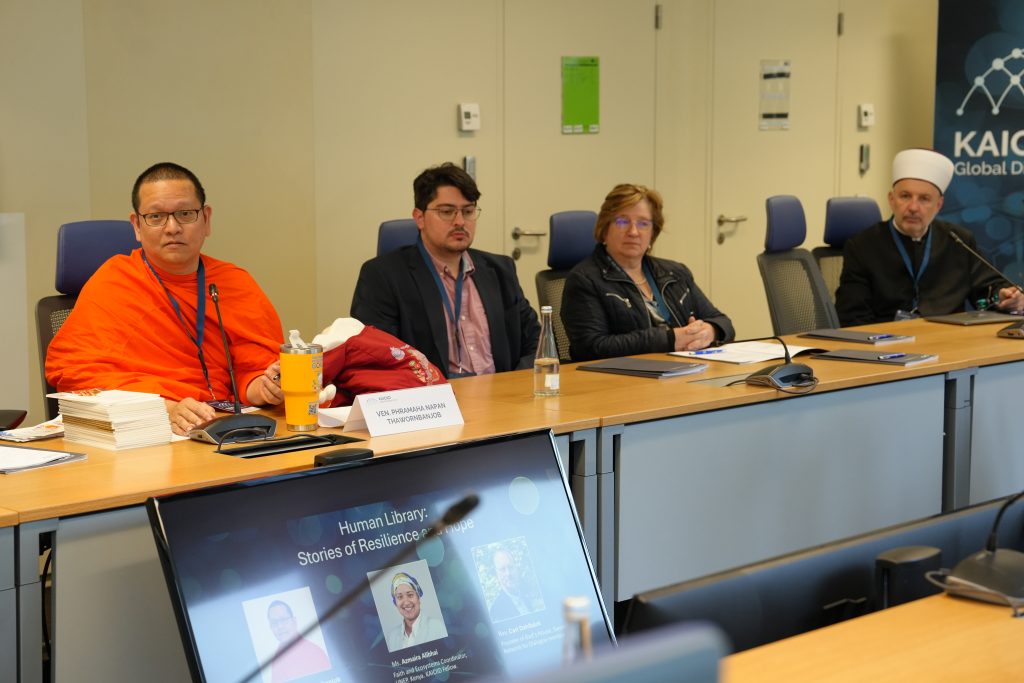
APMA student Ven. Napan as a KAICIID Fellows at the KAICIID 2024 Global Forum in Lisbon (Portugal), 14-16 May 2024. Based in Lisbon, KAICIID (the King Abdullah bin Abdulaziz International Centre for Interreligious and Intercultural Dialogue) is an intergovernmental organisation that promotes interreligious and intercultural dialogue worldwide to prevent and resolve conflicts and foster peace.
His thesis focuses on strengthening collaboration between human rights organisations and Buddhist institutions, embedding rights education within religious networks while drawing on spiritual traditions to promote dignity and resilience. The Global Campus plays a key role in this effort by connecting practitioners across regions; learning from experiences in Africa or Europe, he notes, helps communities in Thailand recognise shared challenges and solutions.
Beyond the classroom, his academic work feeds back into practice.
As Assistant Abbot of Wat Saket (Golden Mount Temple) and founding director of IBHAP, Ven. Napan develops training programmes that apply Buddhist ethics to youth leadership and community resilience. His growing engagement at the international level — including speaking as an interfaith leader at the UN Climate Conference in 2024 — reflects how the programme strengthens his ability to translate local experience into global dialogue, and vice versa.
In a world where religion is often portrayed as a source of division, his work — strengthened by the APMA programme — shows another possibility: faith as a partner of human rights, and education as the bridge between them.