
Internationally acclaimed for his artistic exploration of identity, biocultural diversity, and the interconnectedness of humanity, Vanmechelen’s work reflects a shared belief in the transformative power of art, education, and global engagement to inspire more inclusive, just, and humane societies. In 2017, Vanmechelen created a marble sculpture at the Global Campus of an ancient Greek statue of a child, sitting on the Encyclopedia of Human Rights, entitled Collective Memory, to honour the importance of human rights.
Now Vanmechelen returns to Venice to present We Thought We Were Alone, his first solo sculptural exhibition coinciding with the Biennial of Venice at Palazzo Rota Ivancich. The exhibition, curated by the UK independent curator and writer James Putnam, features 40 new sculptures and installations, created specifically for the occasion. Moving beyond human-centred perspectives, it explores the dynamic relationship between living organisms and the inorganic environment. Moving beyond traditional sculpture, the exhibition positions art as a positive force capable of inspiring social and biological transformation. Palazzo Rota Ivancich not only functions as a backdrop but as a structural part of the exhibition: a layered interior where rooms become thresholds, with the building’s own history of repair and reinvention echoing the show’s central theme, reflecting further the interconnectedness of human beings and nature.
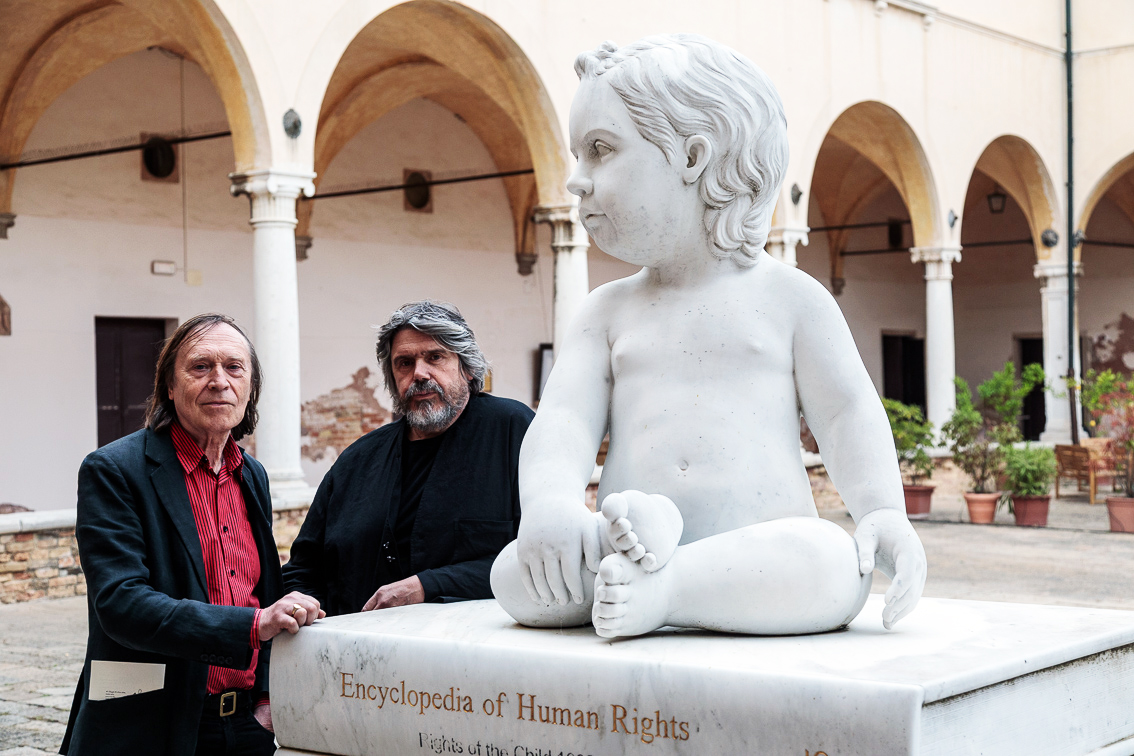 James Putnam and Koen Vanmechelen at Global Campus HQ in Venice Lido
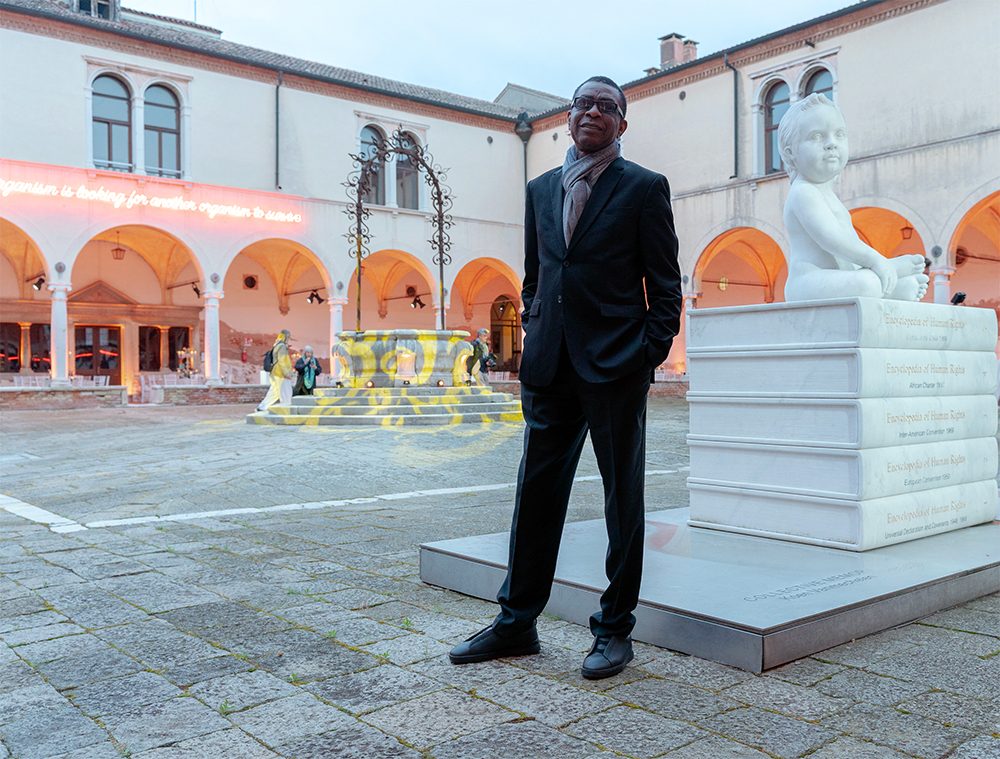 Celebrated singer Youssou N’Dour at the Global Campus HQ in Venice Lido
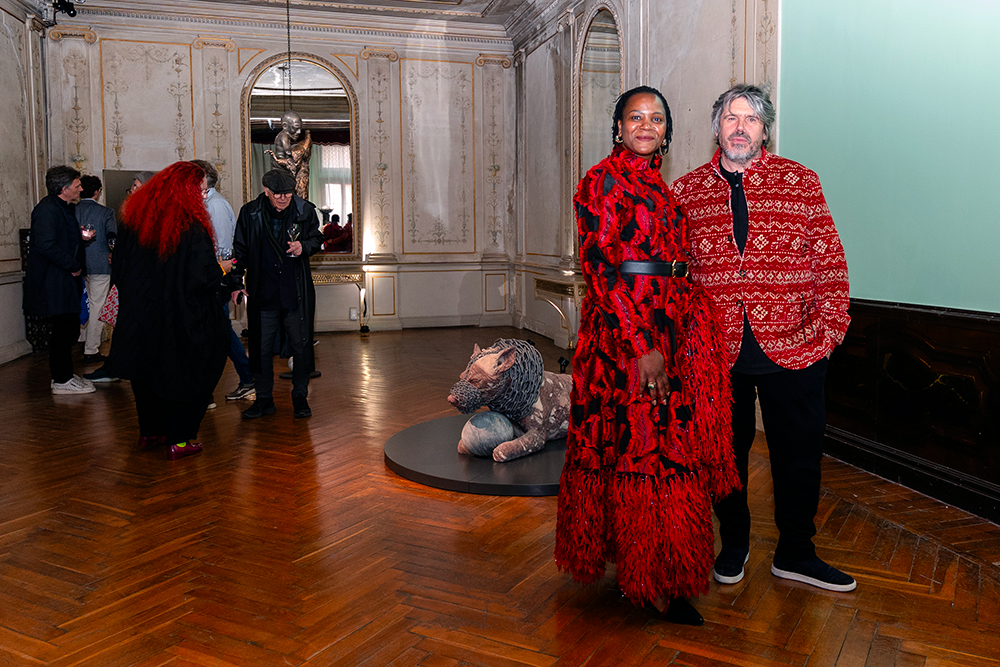
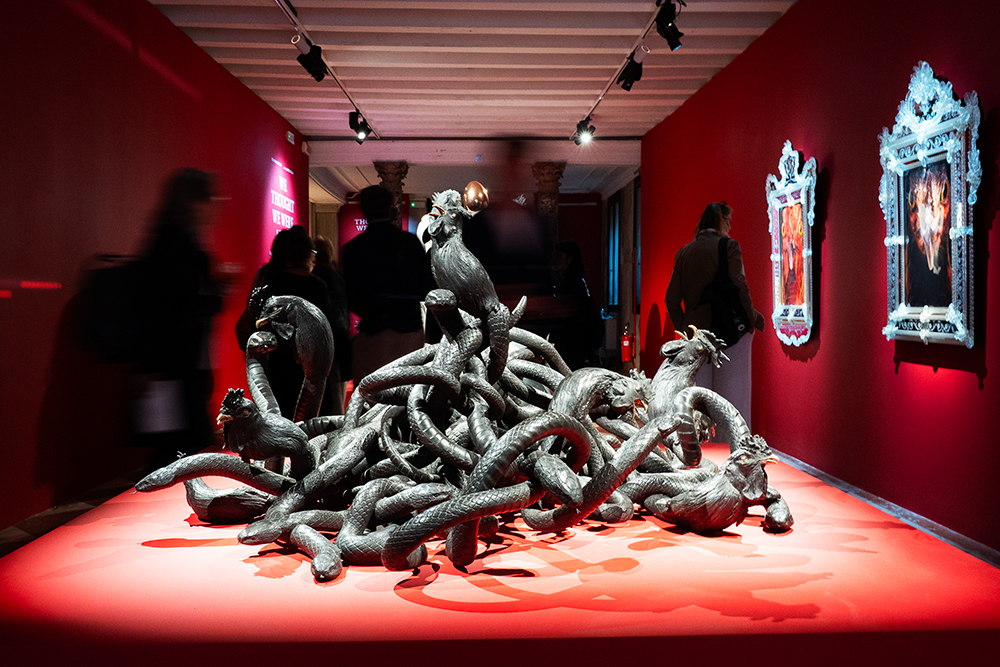
Moving across three floors, the visitor experiences the palazzo as a ‘cocoon’ – a space where forms loosen, reconfigure, and return changed. Materials including bronze, marble, glass, photography, and video are brought together to create a dialogue between past and future, a tension between the individual and the collective, matter and form, inheritance and transformation. Classical statuary is reinterpreted amid a diverse menagerie of animal forms, while the works interconnect biology and culture, the local and the global, solitude and solidarity.
Manfred Nowak says: “For the survival of humanity, we need to broaden the concept of human rights to the rights of future generations, the rights of other species, and the rights of nature, forests, rivers and the ecosystem as a whole. We thought we were alone and that only human beings were endowed with dignity and rights. Now we understand that other species and nature have dignity as well and need to be protected in their own rights. We will only survive as human species if we live in harmony with other species and nature. It is late but not too late. We need to move from major keys to minor keys, slow reflection, resilience, healing, solace, care and restoration. In his creative and innovative work, Koen Vanmechelen has always combined the arts with human rights, animal rights and rights of nature”.
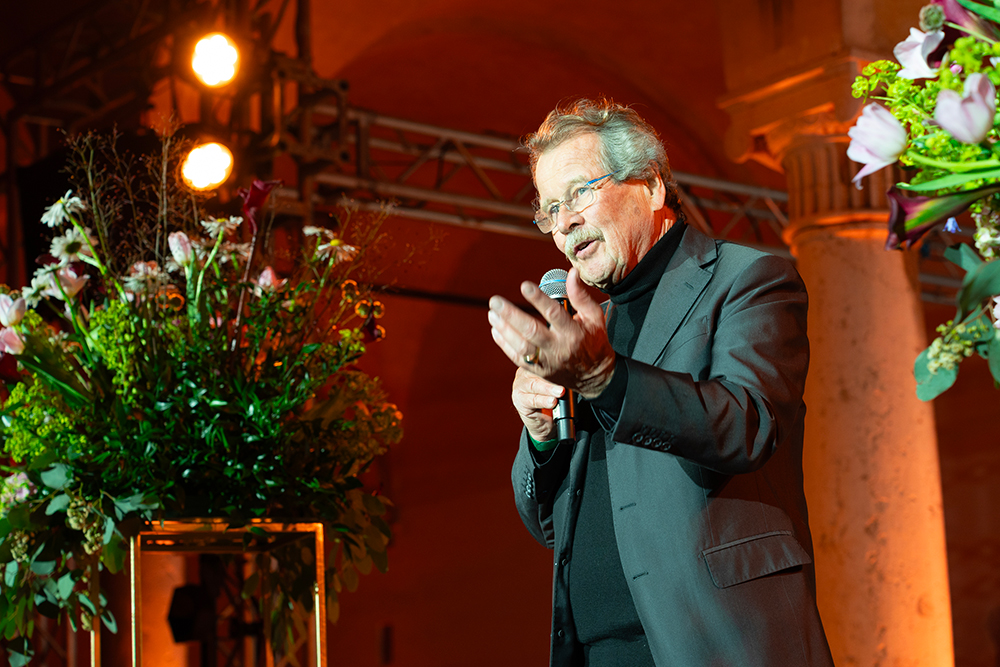
Koen Vanmechelen says: “For centuries we thought we were alone. We imagined ourselves at the centre of all things – the measure of progress, the author of peace, the keeper of paradise, and the pinnacle of evolution. As the exhibition unfolds, the animals reveal themselves, not as metaphors or relics, but as messengers of a different truth. In their gaze, we confront the price of our domestication – how we tamed the world and, in doing so, lost our own wildness. This is not nostalgia for a lost Eden, but a confrontation with the limits of human exceptionalism. Nature does not need our pity, only our willingness to coexist. The minor key of survival is not conquest, but reciprocity and hybridity.”
In dialogue with the Venice Biennale theme, In Minor Keys, the exhibition features a dedicated room exploring Wild Gene Festival, a collaborative project between Koen Vanmechelen and celebrated Senegalese musician Youssou N’Dour.
At the Palazzo, the room presents two videos highlighting the community that brought the festival to life, creating a shared space of music, ritual, and collective creativity. Originally staged on 1 August 2025 at LABIOMISTA Vanmechelens studio and 24h park in Genk (BE), the festival transformed the site into an open-air stage, delivering a co-performance of live music played by Youssou N’Dour and Le Super Étoile de Dakar, which intertwined with Vanmechelen painting a monumental nine-metre canvas in real time.
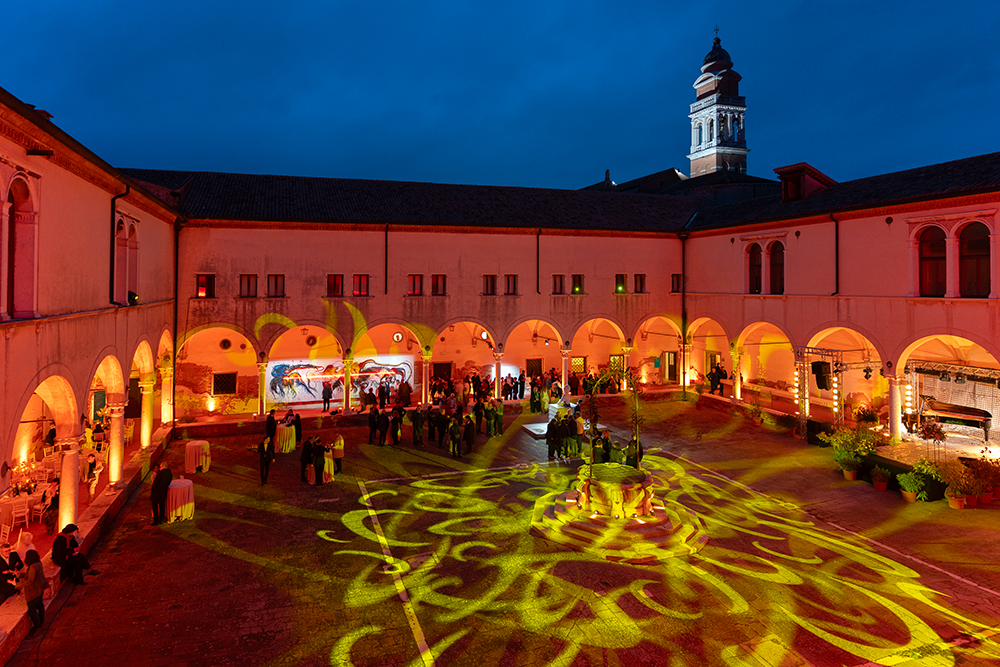
This nine-metre canvas with the Collective Memory sculptures series are being now exhibited at the headquarters of the Global Campus of Human Rights located at the Monastery of San Nicolò in Venice during the opening days of the Biennial. A catalogue will be published by LANNOO in line with We Thought We Were Alone in early September 2026 with a special contribution by our Secretary General, Manfred Nowak.
Youssou N’Dour says: “The Wild Gene Festival installation in Venice transforms the Palazzo into a place where art and music combine, inviting visitors to experience and celebrate the rhythms of creativity and connection through this sonic architecture, bringing sound, gesture, and colour together to reflect identity, community, and the living dialogue between humans and nature.”
Curator James Putnam says: “Vanmechelen’s work goes beyond the idea of interconnected life and engineers conditions in which it becomes visibly unveiled. By staging hybrids, thresholds and fragile systems across the palazzo, he turns a familiar premise into a physical experience: a continuous negotiation between form and transformation.”
For further information, please contact:
At the Global Campus of Human Rights: pressoffice@gchumanrights.org
At the exhibtions: Julia Safe julia.safe@flint-culture.com +44 7837 098 985
Estelle Bolon estelle.bolon@flint-culture.com +44 7707 807 441
Address: Palazzo Rota Ivancich, Calle del Remedio, 4421, Castello, Venice
Nearest vaporetto stop: San Zaccaria
9 May – 22 November 2026
(Preview dates 6 – 8 May)
Opening hours:
Monday – Closed
11am–7pm (May–September)
10am–6pm (October–November)
Free admission
About Koen Vanmechelen
A Belgian conceptual artist whose work explores biocultural diversity through a sustained dialogue between art, science and society. He is best known for long-term projects including the Cosmopolitan Chicken Project, and for creating platforms where research, participation and art meet, such as LABIOMISTA in Genk. Vanmechelen’s work investigates identity, diversity and global interdependence through long-term projects at the intersection of art and science. He translates research into sculptures and installations, often developed through collaborations with scientists and communities. The result is an evolving body of work that treats diversity not as a theme, but as a method. In 2010 he received an honorary doctorate from Hasselt University. In 2013 he won the Golden Nica (Hybrid Art) at Prix Ars Electronica and received the Global Artist’s Award in Venice. His work has been presented internationally, including at the Uffizi Gallery, the V&A and ZKM, and featured in major recurring exhibitions such as the Venice
Biennale, dOCUMENTA (13) and Manifesta 9. He has been invited to speak at the World Economic Forum (2008) and at TED events.
www.koenvanmechelen.be | LABIOMISTA.COM |
About James Putnam
James Putnam is an independent curator and writer. He founded and was curator of the British Museum’s Contemporary Arts and Cultures Programme from 1999 to 2003. Since 1994, he has organised several critically acclaimed exhibitions for major museums, such as the ‘Time Machine’ exhibition at the British Museum and Daydreaming with Stanley Kubrick’ at Somerset House. In the last decade, he has regularly curated projects for biennials, both in Asia and Venice. Putnam studied Art History at London University, was Visiting Scholar in Museum Studies at New York University, and Senior Lecturer in Curating at Central Saint Martins, University of the Arts, London (2004-2011) and Senior Research Fellow: Exhibitions at University of the Arts, London (2010-2021). His book ‘Art and Artifact – The Museum as Medium’ (Thames & Hudson, 2000/10) surveys the interaction between contemporary artists and the museum.
About Youssou N’Dour
Youssou N’Dour is a singer, composer, bandleader and producer, known for his extraordinary vocal range and for introducing international audiences to mbalax, a Senegalese popular music style that blends Wolof traditional instrumental and vocal forms primarily with Cuban and other Latin American popular genres. From April 2012 to October 2012, he was Senegal’s Minister of Tourism and Culture, and from October 2012 to September 2013, he was Senegal’s Minister of Tourism and Leisure.
About Palazzo Rota
Palazzo Rota Ivancich is a historic Venetian palace located in the heart of the city, a short walk from Piazza San Marco. Dating back to the Gothic period and later transformed with Renaissance and Baroque elements, the building carries centuries of layered history. Its elegantly weathered façade opens onto richly proportioned interiors; high-ceilinged rooms adorned with period details, tall arched windows overlooking quiet canals, and a sequence of floors that invite both intimacy and grandeur. The palazzo holds a special place in Venice’s cultural memory, having once been a meeting point for artists, writers, and thinkers, including literary figures such as Ernest Hemingway. Today, its atmospheric spaces serve as a unique stage for contemporary art, where the city’s past converses with the visions of the present