
The climate and environmental crisis is also a crisis of rights, justice and democratic participation. This was one of the key messages emerging from the Graduation Ceremony of the European Master’s Programme in Human Rights and Democratisation (EMA) 2025/2026, held on 20 September 2026 in Venice, where 83 students from 29 countries completed their studies and a new cohort of 80 students from 38 countries began their journey with the programme.
Among the central voices of the ceremony was Ritwick Dutta, environmental lawyer, Founder and Managing Trustee of the Legal Initiative for Forest and Environment (LIFE) and Right Livelihood Laureate 2021. Drawing on more than two decades of environmental litigation and advocacy in India, Dutta highlighted the role of law, communities and democratic participation in responding to the environmental and climate crisis.
“The reality is that, given the level of consumption today, it would be rather naïve to think that the earth can meet the needs of every human being. The fact is that we are consuming well beyond the earth’s capacity to replenish. Climate change adds another layer of challenge to human existence. ‘Change’ is a mild, positive-sounding expression – what the world is experiencing is ‘Climate Shock’ – floods, extreme heat and cyclones are the new normal. Unfortunately, our political and legal systems still consider these as ‘acts of God’ and ‘nature’s fury’. Regular climate shocks have already begun to impact human relations, and will increasingly drive conflict at the local, national and international levels”. Declared Dutta during his keynote speech.
Through LIFE, Dutta has worked to strengthen environmental democracy by supporting communities facing threats to their land and natural resources and by promoting access to information, public participation and access to justice. The organisation received the Right Livelihood Award in 2021 for its innovative legal work empowering communities to protect their resources and pursue environmental democracy in India.
His contribution to the EMA ceremony placed particular emphasis on the responsibilities of the next generation of human rights professionals and on the need to connect legal expertise with the experiences and demands of communities on the front line of environmental challenges.
“There will always be resistance to change. But unless there is ‘creative destruction’ – to use the words of Joseph Schumpeter – of archaic laws, institutions and practices, real societal change will not happen. Advocating for change is not easy. The forces that are bent on protecting the status quo will not give up their elite space. As young defenders of human rights, you should be prepared to face significant opposition. Yet we must recognize that the assault on environmental and human rights defenders is itself a sign that our collective voice matters. The repression is a sign that those in power fear the truth — the fear of being exposed, the fear of being displaced. As your work becomes impactful and brings about real change you should be ready to be labelled as ‘anti-national’, ‘foreign agent’, ‘anti -development’ and even ‘cockroaches’. You all have a challenging task ahead, and the world needs you more than ever before!” As Ritwick Dutta said to the new graduates.
For the new generation of EMA graduates, the challenge is therefore not only to understand the legal frameworks protecting human rights, but also to identify how those frameworks can be used in practice to support communities, hold decision-makers accountable and strengthen democratic participation.
83 graduates, 80 new beginnings
The ceremony marked the conclusion of the 2025/2026 academic year and the opening of the 2026/2027 academic year of the EMA programme.
The 83 graduating students, representing 29 countries, join an international alumni community working across human rights, law, public policy, civil society, academia and international organisations. At the same time, 80 new students from 38 countries begin the programme, bringing new perspectives and experiences to a community connected through 43 participating universities across Europe and beyond.
The ceremony also brought together representatives of the Global Campus of Human Rights, the European Commission, the German Federal Ministry for Economic Cooperation and Development (BMZ), Right Livelihood and the wider EMA community.
Manfred Nowak, Secretary General of the Global Campus of Human Rights, reflected on the significance of the new generation entering the field at a time of profound global challenges. “In addition to mainstreaming children’s rights and rights of future generations, we increasingly put our focus on the human rights aspects of AI and the triple planetary crisis of climate change, loss of biodiversity and pollution. This focus can also be seen in the topics of the Master theses of our EMA students. I am very happy to announce that our commitment to the human right to a clean, healthy and sustainable environment has recently been strengthened by a partnership with the German Federal Ministry of Economic Cooperation and Development, aimed at mainstreaming climate perspectives in all our education, research and advocacy activities”.
The Ceremony also celebrated the achievements and contributions of the wider EMA community, including the annual EMAlumni Award.
The EMAlumni Association announced Johanna Nelles, EMA 2001 graduate, as the recipient of the 2026 EMAlumni Award in recognition of her extraordinary contribution to the protection of women’s rights over more than two decades. “As the principal drafter of the Istanbul Convention and Head of the GREVIO Secretariat, Johanna has built and sustained the world’s most comprehensive international legal framework against gender-based violence — work that is today more necessary than ever, as that framework comes under increasing political attack. Her career is a testament to what tireless, principled commitment to human rights can achieve.” Declared Muhammad Ebaid, President, EMAlumni Association.
The award consists of a marble sculpture entitled “Collective Memory”, generously donated by artist Koen Vanmechelen. The work gives a tangible and symbolic dimension to the recognition of the EMA community across generations, connecting the ideas of memory, collective responsibility and human rights.
“My dear graduates: do not fall into the trap of identifying yourself through hopelessness. There is space for mourning, and healing what is lost to the cruelty of the world, but we must never let our grief turn us passive. As you step out of this beautiful building, into the world, do what you can to turn your pain and anxiety into a power. Apply what you learned in the classroom, but above all apply what you learned from each other. Do not stop listening and learning with an open mind. And most importantly, do not underestimate the power of collectivity.” Auri Elvi Leino, Student Representative.
“Today marks the day on which another generation of human rights defenders comes formally into being, prepared to stand against the injustices of our world. Yet, today calls us not to celebration alone, but also to duty. To my fellow queer colleagues, I renew the call to mobilize and to demand our rights, not merely to request them. And to my esteemed colleagues, past and future graduates of this programme alike: may the fire within you keep on burning, unwavering and undiminished, from dusk until dawn.” Andrea Antonio Orlandi, Student Representative.
The ceremony also recognised the academic achievements of the graduating class and highlighted initiatives supporting the EMA community, including the EMA Internship Programme, EMA Awarded Theses and the Nicola Tonon Scholarship.
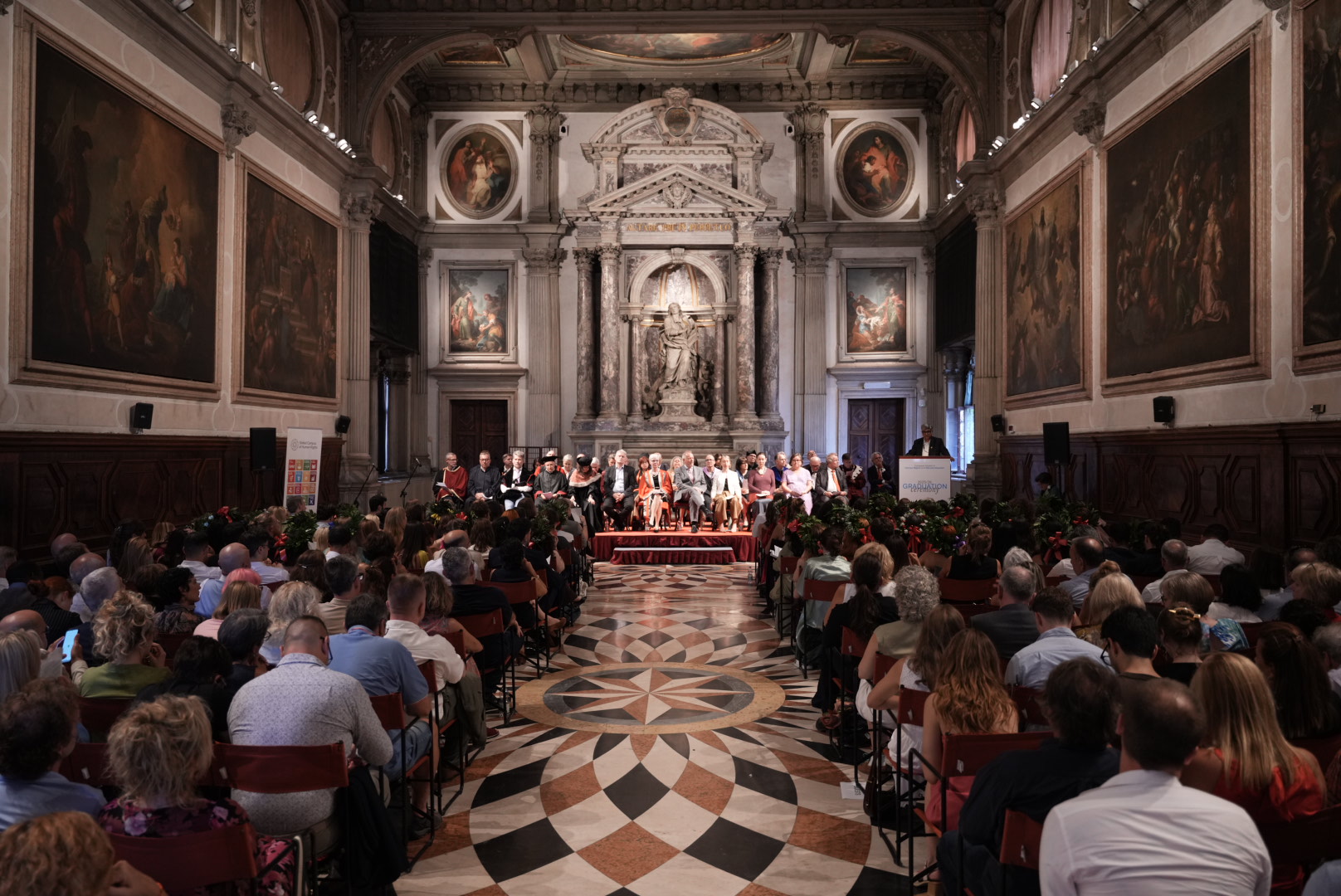
Looking ahead
As one academic year closes and another begins, the EMA community continues to grow across borders, disciplines and generations.
The 2026 graduating class now joins a global network of alumni bringing human rights expertise into legal practice, international organisations, public institutions, civil society and academia. The incoming students, meanwhile, begin a year of intensive study and exchange at a time when the defence of human rights and democratic values requires new forms of expertise, cooperation and engagement.
#GCEurope