
As part of the LLM in Human Rights and Democratisation in Africa programme (GC Africa | HRDA), students are required to embark on an advocacy project on an issue of their choosing. In 2026, a group of nine students — Ansela Sloman, Aya Ghazy, Britney Ngube, Christen Rao, Edward Ssemambo, Grace Jere, Harry Mwesigwa, Maram Mahdi and Sohna Jawara — decided to focus on the use of starvation as a weapon in armed conflict.
In conflicts across Africa and the world, starvation of civilians is increasingly used as a weapon of war through siege tactics, obstruction of humanitarian aid, deliberate destruction of crops and the targeting of marketplaces where civilians access food. Approximately 147 million people worldwide have experienced acute food insecurity as a result of conflict. This constitutes a grave threat to the fundamental human rights to dignity, health and life.
‘Starvation as a weapon of war plays out in several conflicts on the African continent. Being Sudanese, I have witnessed the devastation and loss of life this results in. It was important that we bring greater awareness and action to this issue.’
Maram Mahdi
Inspired by the Global Campus educational digital resource Act Against Forced Starvation, the HRDA students identified a gap in the African human rights system’s guidance on this issue and decided that the objective of their advocacy would be to call for a resolution by the African Commission condemning the weaponisation of starvation in armed conflict. Although this seemed an ambitious goal, with the guidance of Professor Frans Viljoen and Professor Magnus Killander, they decided to give it their best shot.
‘We chose the African Commission because of its unique mandate to interpret the African Charter. Although starvation was already prohibited under international humanitarian law, we wanted a resolution that would remove any doubt that the African Charter also prohibits it and clarify the obligations of African states.’
Harry Mwesigwa
The team implemented a three-pronged strategy to raise awareness and advocate for the resolution: drafting and publishing an opinion piece, circulating an online petition and convening a high-level webinar.
The webinar, held on 23 June 2026, was central to the initiative, providing a platform for stakeholders to consider the proposed resolution and allowing students to present their case directly to decision-makers. Participants included Commissioner Mudford Zachariah Mwandenga, representatives of the African Commission Secretariat, Mona Rishmawi and Professor Joy Ngozi Ezeilo from the UN Fact-Finding Mission on Sudan, and Professor Frans Viljoen, representing the Centre for Human Rights at the University of Pretoria. Representatives of civil society and grassroots organisations working in the Democratic Republic of the Congo and Sudan also shared their first-hand experiences of the effects of weaponised starvation on local communities.
‘The purpose of the webinar was to bring key stakeholders and the African Commission together to discuss our proposal. We wanted to include organisations working on the ground to provide the Commission with first-hand insights into the scale and realities of conflict-induced starvation. UN experts and international humanitarian law specialists also contributed legal perspectives.’
Aya Ghazy
The proposed resolution was positively received by participants, including Commissioner Mwandenga, giving the team hope that their efforts could translate into a concrete legal development.
On 5 August 2026, the African Commission adopted Resolution 666 on the Prohibition of the Starvation of Civilians as a Method of Warfare in Africa during its 88th Ordinary Session. The resolution provides the normative clarity the team had advocated for. It affirms that starvation of civilians as a method of warfare is prohibited in both international and non-international armed conflicts, calls on all parties to refrain from causing or contributing to conflict-induced starvation, and condemns the obstruction of humanitarian relief.
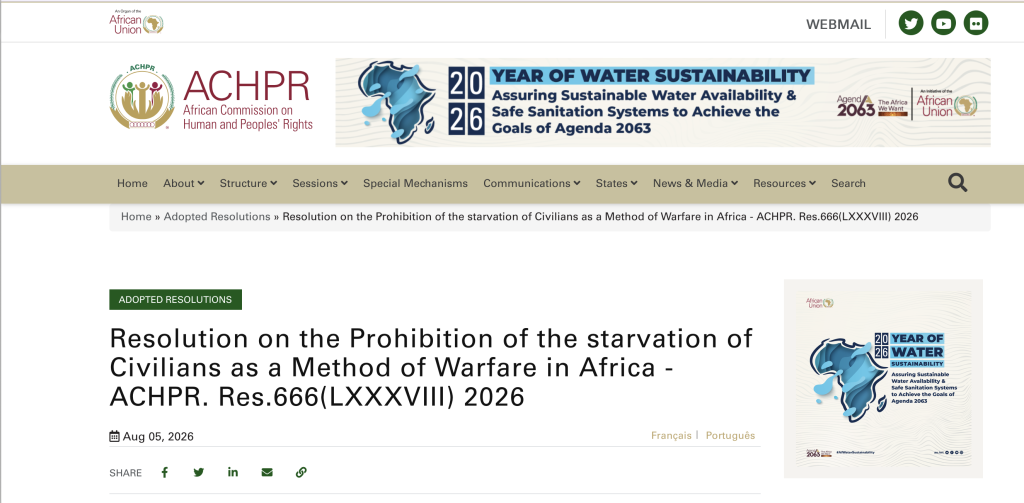
Although this was a victory for the team, the students emphasise that its true impact will depend on implementation.
‘Knowing that our collective efforts had contributed to the adoption of the resolution gave us immense joy and hope, yet we believe that the true measurement of this achievement lies in its implementation and its tangible difference in the lives of those in armed conflicts.’
Britney Ngube
The project gave the HRDA students an opportunity to experience the inner workings of the African human rights system and learn how strategic advocacy can contribute to concrete legal developments.
‘I am so grateful to have been part of this team because it taught me that even a university project can have real-world impact if we have enough passion for the cause, coupled with the right support and hard work. This experience was undoubtedly a highlight of the master’s programme and taught me skills that I will carry with me into my career as a human rights defender.’
Ansela Sloman