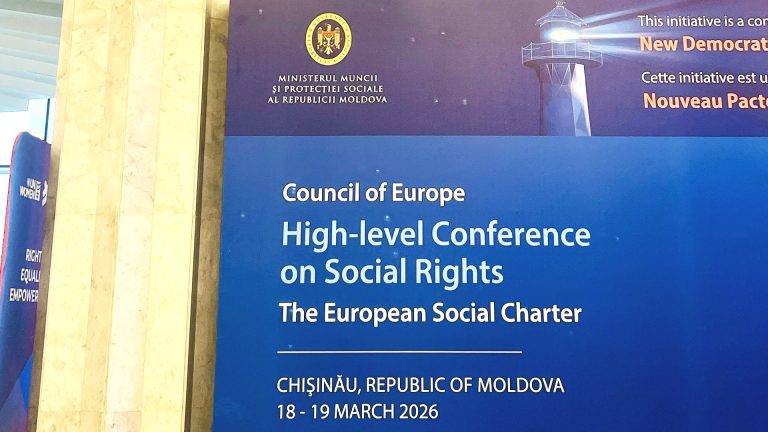
In Chișinău, Moldova—about 60 km from the Ukrainian border—a high-level conference on the role and future of social rights in Europe took place on 18 and 19 March 2026, against a backdrop of rising polarisation and inequality, and growing risks to institutional trust and social cohesion. The event convened ministers and senior public officials, as well as representatives of the Council of Europe (CoE), other international organisations, civil society actors, social partners, academics, national human rights institutions and equality bodies.
This conference forms part of a series of high-level initiatives (including those culminating in the Reykjavík and Vilnius Declarations) which, since 2023, have sought to reaffirm CoE member states’ commitment to strengthening social justice and the European Social Charter (ESC) system. As the CoE’s core instrument in the socio-economic field—complementing the European Convention on Human Rights, which primarily protects civil and political rights—the Charter is framed as a moral, legal and strategic imperative for advancing social justice and reinforcing democratic stability and security.
Boaventura de Sousa Santos’ analysis offers useful parameters for understanding the dynamics at play: even in established (liberal) democracies, weakening social rights, eroding welfare structures, social exclusion, limited accountability and civic participation reveal deep legitimacy crises, resulting in the predominance of ‘thin’ or low-intensity forms of democracy. Relatedly, a notable shift in Chișinău was the way socio-economic rights are framed and valued. As highlighted by several delegates, including Miltos Pavlou of the European Union Agency for Fundamental Rights, these rights are no longer primarily portrayed as protections for the most vulnerable. Instead, they are recast as foundational safeguards for all, ensuring that society remains prepared and resilient against any antidemocratic shifts: the realisation of social rights reduces inequality, strengthens social cohesion, and bolsters institutional trust, ultimately safeguarding democracy itself to the benefit of everyone. This reframing is explicitly reflected in paragraphs 4 and 5 of the just-adopted Declaration of Chișinău, which also welcomes the Secretary General’s initiative for a new Democratic Pact for Europe.
The Declaration does not overlook vulnerable groups, with specific references to women, children, older persons, and persons with disabilities, alongside dedicated conference panels on Roma and young people. In particular, a joint statement by the CoE Human Rights Commissioner and the UN Special Rapporteur on Extreme Poverty highlighted unaddressed structural issues including that around 25 percent of children in the EU live in poverty, with significant social and economic costs, including lost employment, reduced earnings, poorer health outcomes, and increased public expenditure. Recommendations include adopting national anti-poverty strategies informed by the quite unique Article 30 of the ESC that protects against poverty and social exclusion. Digitalisation of social welfare, health illiteracy, limited democratic participation of young people, weakening social dialogue, and the precariousness of platform work—alongside the impact of AI on labour rights—emerged as key concerns in side events that future law, practice and interdisciplinary research on social rights will need to engage with more deeply.
Yet one silence is striking: no explicit reference was made to social protection for the millions of migrants and refugees in precarious situations across Europe (with the exception of the delegate of Norway and myself, in my capacity as representative of the Academic Network on the European Social Charter and Social Rights). This omission is perhaps unsurprising in the current European climate, where a regressive new political declaration on the European Convention on Human Rights and migration is under preparation. Within the ESC framework, excluding those without regular status (in spite of bold ultra-textual decisions by the monitoring body of the Charter) creates a jarring friction with the principles of universal rights and social cohesion. This neglect stands in stark contrast to Recommendation 2304 (2026), in which the CoE Parliamentary Assembly urged an expanded personal scope for the Charter. Such a shift would dismantle the current social stratification among migrants and refugees, replacing arbitrary ‘scales of deservingness’ with a commitment to human dignity.
Despite this gap, the Declaration signals a bolstered political commitment, adopting a more robust language of rights and legal obligations than previous instruments. States reaffirmed their ‘full commitment to the protection and implementation of social rights as guaranteed by the European Social Charter’, covering essential pillars like employment, health and social protection.
Significantly, the Declaration emphasised the authority of the European Committee of Social Rights (ECSR), the independent body of 15 experts that monitors state compliance with the Charter through reporting and collective complaints. This recognition is vital for genuine accountability; however, submissions from both the same ECSR and the CoE’s Conference of INGOs reveal a urgent need for increased funding. This critical monitoring work currently rests on the shoulders of just fifteen non-full time ECSR members, and especially a dozen dedicated CoE staff members—a remarkably thin foundation for such a vast mandate on social rights monitoring in 42 CoE member states.
Throughout the conference, a clear leitmotif emerged among delegates: a transition from mere recognition to greater implementation, and this must include equipping regional and local authorities with the resources necessary to breathe life into social rights, particularly the right to housing, the neglect of which remains a primary driver of Europe’s current cost-of-living crisis.
The consensus was clear, as even reiterated by Alain Berset, CoE Secretary General: no more words without action—specifically, the need for genuine implementation of the European Social Charter. Notably, eight other member states used the conference to expand their obligations under the ESC. Unlike traditional treaties ratified in full, the Charter’s flexible structure allows states to incrementally ‘opt-in’ to additional provisions (beyond a minimum threshold) with the ultimate aim of full acceptance (Article 20 of the 1961 ESC and Article A of the 1996 Revised ESC).
Arguably the most significant development came from the French delegate, who announced the extension of the Charter’s application to France’s overseas territories (Article L.2 of the Revised ESC). This move brings approximately 2 million additional people under the Charter’s protection. Crucially, it enables supervisory mechanisms to operate in (post-)colonial contexts where environmental degradation and social rights violations have been particularly acute. For example, cases concerning access to drinking water and poisoning by chlordecone in Guadeloupe and Martinique—previously declared inadmissible by the ECSR due to jurisdictional gaps—may now finally gain legal traction.
Finally, shifting the narrative as the Declaration itself recognises: when we speak of investment, we must mean investing in people. Such investment is the bedrock of social cohesion, institutional trust, and the reinforcement of democracy. Seen in this light, domestic and international social rights guarantees are not a cost, they are an asset. The Chișinău delegates have officially pledged a renewed commitment to operationalise the European social model. As ECSR President Aoife Nolan emphasised, the urgency of this work cannot be overstated: reflecting on the challenges of today’s ‘polycrisis’, she noted: ‘Never have people of Europe needed social rights more’.