The festival, supported once again by Right Livelihood, was organised on December 12-13 2025 by a team of 8 student coordinators who were supported by 20 other students, all volunteering their time in advance of and during the Festival days. The level of attendance was very satisfactory – having reached a peak of around 90 people on Saturday evening! – and the audience gathered a joyful mix of EMA students and Venetian residents.
Taking place in the Global Campus Headquarters in the Monastero di San Nicolò in Lido, Venice, the title of this year’s Festival was “Un, Due, Tre…Stella!”, drawn from one of the most beloved childhood games in Italy (i.e., the Italian version of the children’s game known in English as “Red Light, Green Light). What began as ‘stai là!’ (‘stay there!’) gradually softened into ‘stella’ (‘star’), a transformation born from the rhythm and imagination of children themselves. The students chose this title because it reflects what they aimed to celebrate: the right to play, creativity, spontaneity, and resilience that define childhood. ‘Un, Due, Tre… Stella!’ is more than a game; it is a shared cultural memory, a reminder of the joyful, inventive ways children can make sense of the world. Therefore, the 2025 Film Festival was an invitation to the audience to tap into their own childhood spirit, remembering that the right to play must not end.
The opening and closing movies of the festival were “Lunana: a yak in the classroom” by Pawo Choyning Dorji (Bhutan) and “Homework”, by Abbas Kiarostami (Iran). By focusing on exploring the role of playing for children and how they make sense of school and of the social dilemmas that stem from it, these movies encapsulate greatly how to see the world through the eyes of children. The film programme was further composed of a very diverse list of short movies, several of them responding to an open call organised by the students. In a short period of time a wide range of movies from activists and Human Rights advocates from all around the world were submitted, the festival’s Film Programming team curated a selection of the best ones. See the full programme on the website.
It was very important for the student coordinators to go beyond adult talks about children’s rights and to give space to the voices of children. Thus, with the help of the GC team and building on a fruitful partnership with I.C. Dante Alighieri in Venice, children from the P.F. Calvi school took part in a workshop organised and facilitated by students from the EMA programme, a few weeks in advance of the festival. The children were invited to choose an important human right to them and to make a drawing based on its personal meaning. Each child used great imagination to draw beautiful representations of the rights they want to see upheld in their day-to-day lives. Accordingly, during the festival, Saturday morning was solely dedicated to an inter-generational approach to the right to play, where the children’s artwork was exhibited and a documentary made by EMA student Emily Malkin based on this workshop and the experience of playing in Venice was screened.
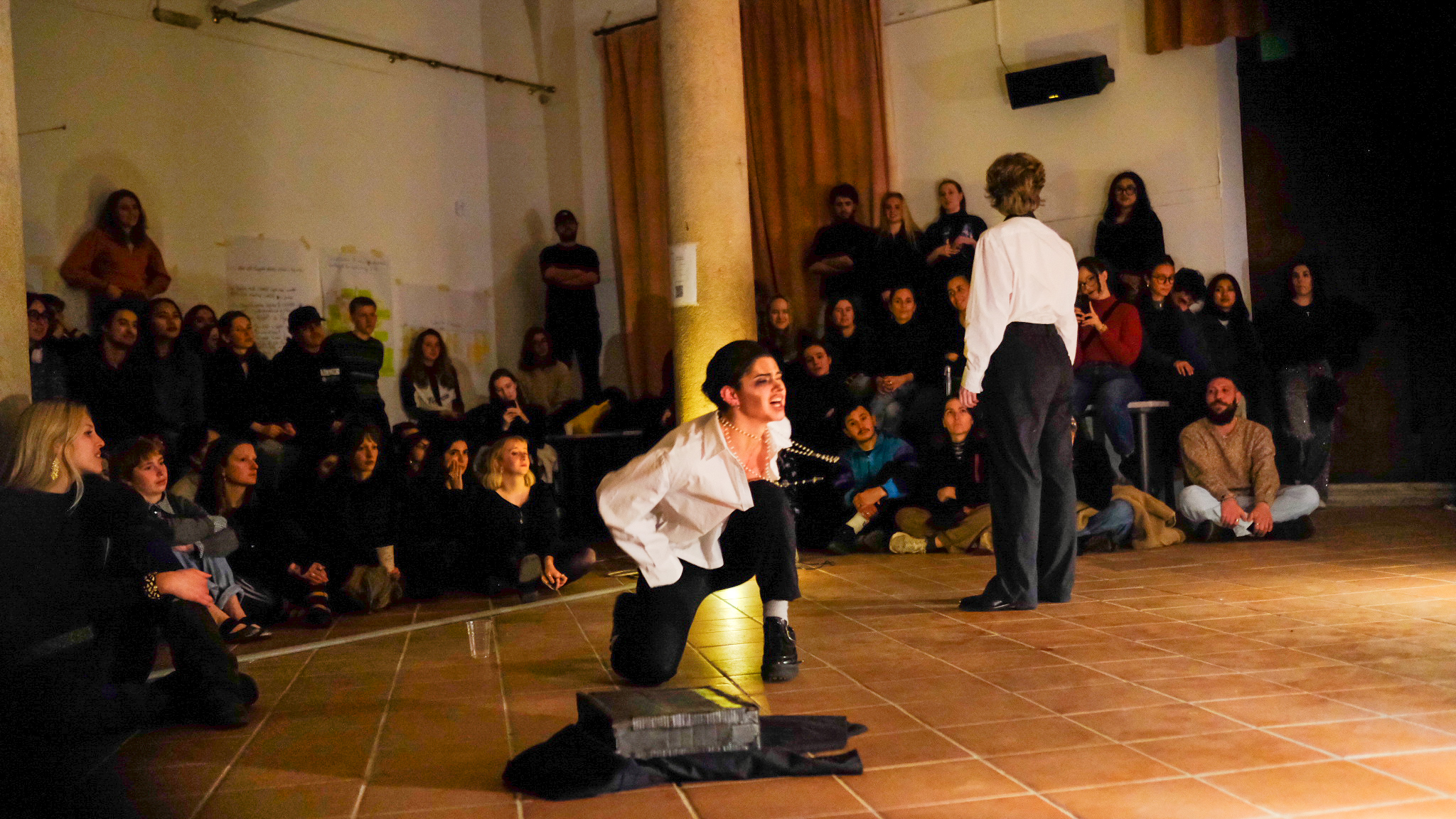
Furthermore, the public programme included discussions on the right to play: especially relevant was the talk on the UN Convention on the Rights of the Child by the Honorary Judge of the Juvenile Court of Florence Sofia Ciuffoletti. After having discussed the importance of playing to the dignity, development and freedom of human beings, this right was put in practice by the performances that closed each one of the festival days. With Disco Zenith Laguna, the musicians’ improvisation paved the way to a session of fun and of enjoyment for all the participants. In addition, the EMA student-led band’s performance showed how studying the right to play can be complemented with actual playing. The interaction between the audience, the students and the guests originated two days of a deep involvement in the right to play and in the children’s own worldview.
Through this festival, the students of the EMA Programme aimed to place children’s perspectives at the centre of the discussion on the right to play. The festival’s core lied in an intergenerational approach to the right to play. Hence, the Monastero di San Nicolò became a place where all participants could rediscover the transformative power of play.
Written by Constança Rodrigues Fraga dos Santos Seabra, EMA student