
Drawing on field research and direct engagement with local communities, Vita has explored how environmental policies affect marginalised groups, particularly women. Developed as part of the Global Campus Alumni 2026 Project Scheme, her two complementary publications—a policy brief, Women’s Economic Participation and Community-Based Textile Recycling in Indonesia: Evidence from the Bank Pakaian Initiative, and a practical implementation toolkit—translate both research findings and field experience into policy recommendations and practical guidance for practitioners.
Reflecting on her work, Vita explains:
“Over the past few years, I have been working on the ground in Indonesia, conducting field research, interviewing local communities and looking at how environmental policies actually impact marginalised groups. This hands-on experience listening directly to women navigating daily economic and climate challenges is what drove me to dive deeper into community-led initiatives and advocate for gender-responsive environmental solutions.”
Her research focuses on the Bank Pakaian initiative, a community-based textile recycling project that demonstrates how environmental action and women’s economic empowerment can reinforce one another. As Vita notes:
“These women are not just bystanders or victims of environmental crises; they are resourcefully leading local solutions. By collecting, sorting and transforming discarded fabric into new, sellable products, they are building a local economy that reduces waste while gaining their own financial independence and a real say in household decisions.”
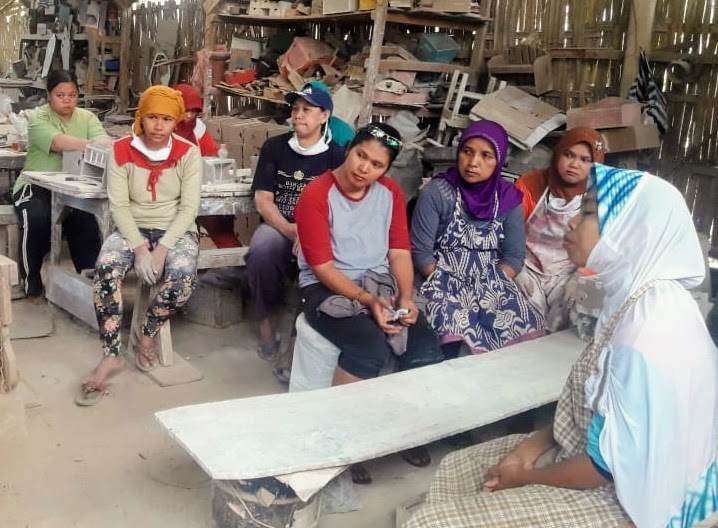
The policy brief demonstrates that community-based textile recycling can provide women with meaningful opportunities for economic participation while contributing to environmental sustainability. Rather than treating textile waste solely as an environmental issue, it connects sustainable fashion, clothing redistribution and gender-responsive environmental justice, offering evidence-based recommendations for local governments, civil society organisations and other stakeholders seeking to support and scale women-led initiatives.
Complementing the research, the accompanying toolkit translates these findings into practical guidance for implementation. Designed for community leaders, civil society organisations, educators and practitioners, it offers adaptable tools for establishing or strengthening community-based textile recycling initiatives. Drawing on the experience of the Bank Pakaian initiative, it provides practical guidance on community mapping, skills development, circular systems thinking, women’s leadership and sustainable livelihood creation, encouraging locally driven circular economy models that recognise women’s knowledge and lived experience as the foundation for lasting environmental and social change.
Vita believes that discussions about the green transition should pay greater attention to the people driving change at community level:
“When we read about the green transition or the circular economy, the conversation almost always focuses on big corporate policies, advanced recycling tech, and industrial efficiency. What usually gets left out of the picture are the actual people at the bottom of the ladder doing the heavy lifting.
Together, the policy brief and toolkit demonstrate how human rights research can move beyond analysis to support practical, community-led action—providing both evidence for policymakers and concrete resources for practitioners working at the intersection of gender equality, environmental justice and sustainable development.
Both publications are available through the Global Campus Human Rights Repository:
Written by Vita Luftiah, APMA alumna (Indonesia), Class of 2024. Vita currently works as Executive Account Manager at Indonesia Medica.