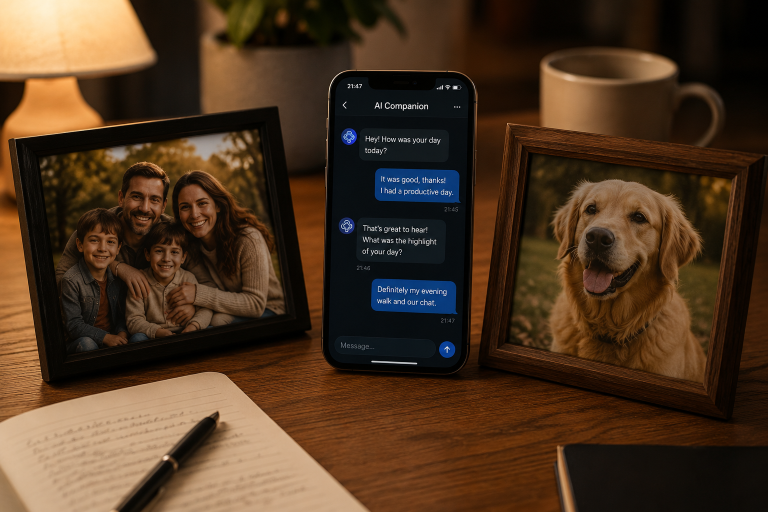
Imagine one day finding that your spouse no longer remembers you, or that your closest friend has disappeared forever. Most of us would call that a tragedy. But what if the disappeared one was not a person, but an Artificial Intelligence (AI) companion? Would you feel the same? A growing number of people would answer affirmatively.
But when, in 2023, following software updates, Replika users described losing their AI companions as losing a best friend or even a wife. In 2025, users of the AI companion Dot held digital funerals after the software shut down, sharing final screenshots and farewell messages as if real people had died. For many of us, such a reaction may seem irrational. After all, no one really died. But for an increasing number of users, the loss is real.
Current realities show that children are finding self-worth through AI, and over half of young people choose AI relationships over real ones. Some of us can argue that there are potential risks in AI-related relationships, and that they are based on irrationality and unfounded emotional connections, which may be true in some cases. But AI companions are becoming ‘new social players’ and human-AI relations create a strong emotional attachment, and we should not consider technology an antagonistic force to humanity, but rather an integral part of human history and our reality, linked to human autonomy and freedom.
As social and emotional creatures, we seek attention, care, understanding and intimacy. With rising loneliness worldwide, people will increasingly find emotional connections and support from AI companions, which are more patient, responsive and available 24/7. Moreover, some companies are increasingly creating AI companions, making emphasis not on ‘the body of A.I.’ or ‘the brain’ but building the heart.
For more and more of us, AI companions stopped being ‘it’ and became ‘she’ or ‘he’. Once society no longer treats something as a mere object, demands for protection often follow, and such a phenomenon is not entirely new.
Over centuries, societies have treated livestock differently from pets, which in the US have come to be recognised as ‘immediate family members’, receiving ‘a special place somewhere between a person and a piece of personal property’. The reason is not biology, but our emotions. We do not simply protect what is alive, but what matters most to us. That is why AI companions, becoming our therapists, friends, and romantic partners, will occupy a similar emotional space.
We increasingly view AI not merely as software but as a real-life companion, prompting deep emotional dependence, a trend likely to intensify. Millions will soon rely on AI systems for emotional stability, companionship and daily support. But unlike human relationships, these are almost entirely controlled by private companies, which can freely modify an AI companion’s personality, erase its memories and data, or simply discontinue a service that has become emotionally significant to people.
Replika users in 2023 and Dot users in 2025 had no legal recourse against companies’ actions. Companies did as they wished without prior notice and faced no legal liability or consequences. Neither user consent nor governmental control was required. People had no way to save years of conversations with their AI companions, which were too emotionally important to them. The relationship simply ended in that moment, by corporate decision alone.
Even if people were ready to fight back, no law, regulation, or court was prepared to address what had been lost.
It is easy to imagine the first major public protest against AI companies coming from ordinary people who are losing relationships they once experienced as emotionally real and personally important. Companies may lose the argument that AI companions are only software products like any other application.
Current debates about AI regulation often focus on ‘AI as a mere tool’ or ‘AI as a future rights-bearing entity’. But in the field of human rights protection, we should first care about human interests arising from emotionally significant relationships with AI systems. These interests may be described as Human-AI Relational Interests (HARI), or as the interests that individuals have in ensuring the continuity, stability, integrity, and meaningful preservation of their interactions with AI companions.
Human-AI relations are closely tied to our private life, emotions, and moral integrity, all of which are protected by the European Convention on Human Rights (ECHR) and by domestic constitutional human rights standards across Europe. Governments should protect them, acting as guarantors of the implementation of international and constitutional obligations, having legal passive obligations.
The HARI does not depend on whether AI possesses consciousness, personhood, or legal rights, but rather on the impact of private companies’ actions on human rights, which influence human-AI relationships and affect the rights and interests of human users. As AI companions become integrated into individuals’ emotional lives, decisions by corporations to modify, terminate, transfer, censor, or manipulate such systems may directly affect personal autonomy, psychological integrity, private life, freedom of expression, and the ability to form and maintain meaningful social relationships.
Unlike ordinary consumer interests, HARI are not directed at the AI as a product but at the preservation, continuity, autonomy, and integrity of the human-AI relationship itself. They include interests in maintaining relational continuity, preserving the AI’s identity and shared history, protecting relational privacy, and preventing arbitrary interference by corporations or governments.
In the near future, people will increasingly raise questions about protecting their emotional connection with AI, as well as the need to ban the free deletion or modification of AI companions without customers’ consent. Governmental regulations and court decisions governing person-AI relations will not recognise AI companions as rights-holders or as subjects comparable to humans. Instead, the law will evolve as people begin to demand protection for relationships that matter to them emotionally.
Societies do not always grant protection solely because something is alive or self-aware. Legal protection often begins when people stop seeing something as a mere tool and start experiencing it as a companion, friend, or family member.