“The school was eye-opening. It introduced practical tools and created a gateway to connect with human rights networks across the Asia-Pacific, strengthening solidarity and joint collaboration.”
2026 participant
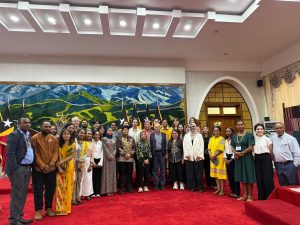
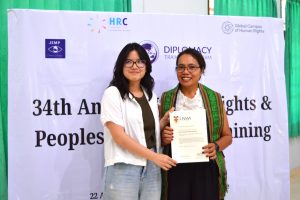
From 21 August to 5 September 2026, Timor-Leste welcomed another cohort of human rights defenders from across Asia and the Pacific for the 34th Human Rights & Peoples’ Diplomacy Training Program.
The residential, itinerant and intensive programme was organised and delivered by the Diplomacy Training Program, affiliated with the University of New South Wales in Sydney and the Global Campus of Human Rights – through its GC Asia Pacific programme, together with the Human Rights Centre at the National University of Timor-Leste (HRC-UNTL), the Judicial System Monitoring Programme (JSMP) as well as in partnership with FORUM-ASIA, and the Pacific Islands Associations of NGOs (PIANGO)
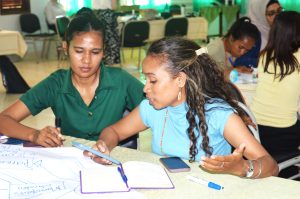
Organised as a summer school-like activity over two intensive weeks, the 2026 edition of the training allowed participants to learn from leading experts and from one another, acquire or refine practical tools and skills, as well as strengthen regional connections and solidarity for promotion and protection of peace and human rights.
Established in 1989 by Nobel Peace Laureate and Timor-Leste President José Ramos-Horta, the programme has grown into a long-standing regional platform for practical human rights education. Its participatory approach brings international standards into direct conversation with the experience of advocates working in diverse communities across the region.
The 2026 edition was opened by Prof. Surya Deva, UN Special Rapporteur on the Right to Development, and continued with sessions on human rights education, economic, social and cultural rights, climate justice, advocacy, accountability, ASEAN mechanisms, peoples’ diplomacy, inclusive movements, and engagement with the United Nations. Workshops, role plays, films and participant-led exercises gave the programme a strong practical focus.
Among the highlights, there is Prof. Justine Nolan’s three-day module on core human rights concepts and standards, UN treaty bodies and other mechanisms, including the UN Guiding Principles and human rights due diligence. Afterwards, Dr Michael Hayes – GC Asia Pacific Director– connected rights-based approaches with development and climate justice, while Arul Prakkash, Yuyun Wahyuningrum and Joshua Cooper guided work on advocacy filmmaking, ASEAN and peoples’ diplomacy, Indigenous Peoples’ rights, UN forums and the Universal Periodic Review.
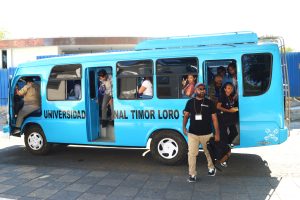
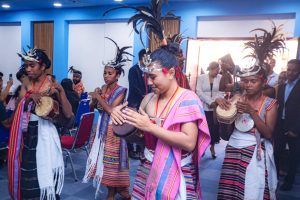
The learning extended beyond the classroom. Participants visited the Timorese Centre for Memory Reconciliation (Chega!), the Resistance Museum, memorials in Liquiça, Maubara, as well as the Aipelo Prison and historical Dare area, allowing them to exchange perspectives with survivors, civil society groups and public institutions. An extraordinary meeting with President José Ramos-Horta examined Timor-Leste’s experience of becoming a beacon of human rights, peace and democracy. On 4 September, the group also visited the Ministry of Foreign Affairs and Cooperation, where H.E. Jesuína Maria Ferreira Gomes, Vice Minister of Foreign Affairs, welcomed participants before sessions on Indigenous Peoples’ rights.
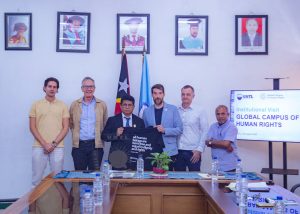
Co-hosting another successful edition of the Human Rights and Peoples’ Diplomacy Training in Dili also reinforced the long-standing cooperation between the Global Campus and the National University of Timor-Leste (UNTL). The UNTL Human Rights Centre, established together with the Global Campus thanks to European Union support between 2019 and 2022, continues to strengthen Timor-Leste’s role as a regional meeting place for human rights educators and defenders. During the programme, UNTL Rector Prof. Joviano António da Costa, GC Asia-Pacific Director Dr Michael Hayes, GC Head of Capacity Development Adriano Remiddi, GC Capacity Development Officer Vukašin Pajović and DTP Executive Director Patrick Earle met to discuss the ongoing cooperation and agree on institutional priorities for the next three years.
The regional school and training were made possible through the support of its partners, including co-funding from the Italian Ministry of Foreign Affairs and International Cooperation.
This project is part of the GC Capacity Development programme. For more information, contact Adriano Remiddi – programme manager, Vukašin Pajović, and Larisa Barbu – programme officers at capacity.development@gchumanrights.org