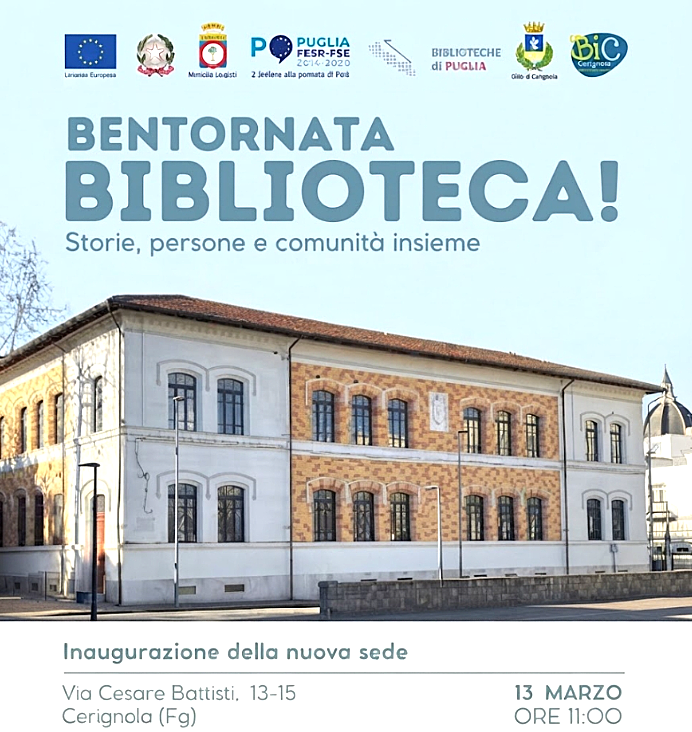
On 13 March 2026, residents of Cerignola, a town (population: 57,700) in southern-Italian Puglia region formed a human chain to bring the last books from the old municipal library to their new home in the renovated school buildings. Community members and local authorities have given the new library the name of the founder of one of Italy’s most popular dictionaries: Nicola Zingarelli. We argue that the recent initiatives in Cerignola raise critical human rights issues: by opening a Community Library that provides health information to the linguistically marginalised population in an accessible language, a State respects its obligation to ensure the right to health. Therefore, we propose the concept of public bibliotherapy.
The Universal Declaration of Human Rights enshrines the enjoyment of a broad range of rights, including the rights to information (Art.19) and participation in cultural life (Article 27). Italy has ratified the International Covenant on Economic, Social and Cultural Rights (ICESCR), which protects the rights to participate in cultural life (Article 15) and the highest attainable standard of health (Article 12). Italy’s Constitution (Article 32) protects health as a fundamental right and a collective interest. The Covenant’s monitoring body, the Committee on Economic, Social and Cultural Rights (CESCR), interpreted these norms in General Comment No.14 stating that the right to health includes the right to health information, and General Comment No.21 recalling that libraries are examples of cultural institutions, the accessibility of which is a priority. Though non-binding, these soft-law authoritative interpretations clarify that states must actively promote health information in locally intelligible languages, not merely refrain from restricting it.
A report published in 2024 by the Council of Europe with the support of the European Union describes health literacy as a human rights concept. The report provides evidence that almost half of the Europeans have only a limited level of health literacy. During the side event in Chisinau on 26 March 2026, the speakers emphasised that this is a major obstacle to achieving the rights provided for in Article 11 of the European Social Charter. States bear particular responsibility to reduce health inequalities and ensure accessible healthcare for socially vulnerable groups.
In Italy, where standard Italian is the official language, many older Southerners and migrants speak dialects or other native languages in daily life. Law 482/1999 protects historical linguistic minorities but not regional Romance varieties. Such linguistic distance can reduce satisfaction with care and compromise its quality and safety, for instance when instructions, consent forms or medication leaflets are only partly understood.
The Cerignola Community Library responds concretely. It offers the Zingarelli dictionary free of charge to every user as a Community Dictionary. A commercial reference work thus becomes a shared linguistic resource: anyone, regardless of income or schooling, can check the meaning of a diagnosis, a prescription or an administrative form. This is a monolingual dictionary of standard Italian; it does not translate dialects or migrant languages and cannot replace interpreters or cultural mediators. Its human rights significance lies elsewhere. By removing economic and symbolic barriers to the standard language, it creates a linguistic commons, which supports the right to health information, the right to participate in cultural life and equality of opportunity.
The evidence is circumstantial, but not insignificant: a study conducted at Yale University in 2016 among 3,635 participants over 50 showed that book readers died during the 12-year observation period 20 percent less frequently on average than those who did not read. Risk was even lower after adjustment for age, sex, wealth, and education, yet this does not prove that book reading prolongs life, as confounders were not addressed. However, the results of the study confirm once again that reading books contributes to health. Cerignola’s first three months of experience are also promising, although they speak not so much about health outcomes but rather about opportunities: more than 7,500 new visitors, 526 new subscribers, and 1,293 participants in library workshops. Nevertheless, not every library is a clinic.
This is why the books’ journey matters. A collection that is boxed up or in transit cannot be borrowed, consulted or shared, and an inaccessible collection benefits no one’s health. This assessment is based on Article 12 ICESCR, which obliges states to take measures to the maximum of their available resources to ensure the right to health. CERSC’s General Comment No.14 contains an important clarification: states must pay special attention to deliberately regressive measures, the justification for which they bear the burden of proof. requires health facilities, goods and services to be available, accessible, acceptable and of good quality, with accessibility expressly including information. In addition, England has integrated social prescribing into its National Health System (NHS) since 2019, and the UNESCO Public Library Manifesto promotes public libraries as social and health hubs.
Seen thus, the above-mentioned human chain was more than symbolic: it restored availability and accessibility, turning a stored inventory into a living public service. In Cerignola, the books had to leave their boxes before they could make anyone healthier. By international human rights standards, States must ensure such opportunities in all communities, and when a library is forced to close, the question arises not only of the costs but also of the legitimacy of its actions.
Looking ahead
Cerignola shows that a library can be a rights-based public health asset, but its experience should not remain local. European momentum exists: according to its concept note, the Council of Europe will hold a High-Level Conference on Health Literacy and Human Rights in Rome on 4 December 2026, aiming to adopt a Rome Declaration and enlarge a Coalition for Health Literacy and Human Rights. As a party to the ICESCR and the Revised European Social Charter, Italy can translate this commitment into domestic practice. We recommend four steps.
First, the Ministry of Health, with the regions, should integrate health literacy into national planning, produce plain-language health information and, where appropriate, versions in dialects and migrant languages, and partner with libraries to disseminate it.
Second, the Ministry of Culture and Parliament should recognise public libraries as infrastructure relevant to the right to health, secure stable funding and require a documented human rights impact assessment before any closure, in line with the duty to avoid unjustified retrogressive measures.
Third, the Government should join or actively support the Coalition and the Rome Declaration, while ISTAT should measure health literacy nationally, disaggregated by language and age.
Fourth, universities and municipalities should evaluate community libraries rigorously, tracking health literacy and access to services rather than attendance alone, so that public bibliotherapy rests on evidence.
If rights are to leave their boxes, as Cerignola’s books did, they need institutions, funding and evidence.