Everyday life in Bishkek (a city of roughly 1.2 million residents) increasingly features long lines of cars idling in traffic and pedestrians covering their mouths against the haze of smog. Over the past decade, the number of registered vehicles reached around 400,000 private cars, far exceeding the city’s original infrastructure capacity. Kyrgyzstan’s capital, once celebrated for its greenery and fresh air, now endures some of the world’s worst winter pollution. The surge in private car ownership, with five times more cars on the road than a decade ago, has overwhelmed the city’s roads and contributed to hazardous air contamination.
For many residents, especially those in the city’s poorer outskirts, daily commutes have become soul-sucking journeys through congestion and pollution. On average, Bishkek commuters travel 30.7 minutes one-way over 8.3 km to work or school. Nearly 50 percent of working residents spend 45–90 minutes round-trip commuting. Between July and September 2024, Bishkek residents logged a combined 777 hours stuck in traffic jams. This is more than just an inconvenience; it’s a manifestation of environmental and spatial injustice. What should be basic rights; clean air, a safe commute and accessible services, are increasingly luxuries in Bishkek.
Choked by traffic, smog and inequality
The result is evident in the daily reality: parents spend hours in traffic to get to work, children in peripheral novostroika settlements travel to distant neighbourhoods just to attend school, and everyone breathes in the capital’s polluted air. The burdens of this car-centric, sprawling urban model are not evenly distributed – they fall hardest on those who have the least ability to avoid them. In Bishkek, as in many cities, environmental harm is entangled with social inequality.
Poorer families living in far-flung districts or near busy roads inhale more toxic exhaust and spend a larger share of their day commuting, while more affluent residents can afford homes near the centre or drive air-conditioned SUVs. The situation raises fundamental human rights concerns: the right to clean air, the right to safe mobility, and the right to equitable access to the city are all at stake.
The Trolleybus elimination: backwards steps on clean air
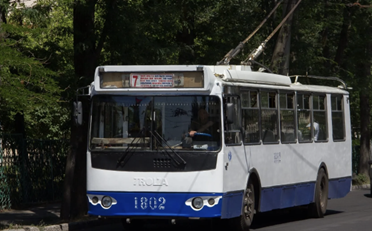
Despite the advantages of the trolleybus system, which ran on electricity and produced zero tailpipe emissions making them the city’s greenest public transport, in spring 2024, City Hall abruptly announced plans to eliminate trolleybuses altogether, transferring existing vehicles to other towns and tearing down the web of overhead wires. Officials portrayed the trolleybuses as old-fashioned, slow, and costly to maintain. They argued that battery-powered electric buses (to be bought with a 50m USD Asian Development Bank loan) would eventually replace the trolleys. In theory, the idea of new electric buses sounds environmentally friendly, but in practice, the city’s approach was deeply flawed.
First, the scale of the replacement does not match what was lost: the initial order of 120 e-buses is not enough to substitute all trolleybus routes, and many of those e-buses had yet to arrive when the trolley wires were taken down. Meantime, officials turned to diesel and compressed natural gas (CNG) buses—a puzzling choice in a city suffering grave air pollution, since CNG and diesel still emit pollutants.
Second, the trolleybus removal happened hastily and without public consultation. Activists point out that no clear information was offered to residents before this decision and required public hearings were skipped or rushed. The response from civil society was swift. A diverse coalition—urban planners, environmentalists, public transport workers, cyclists and socialist-leaning groups—united under the banner ‘Save the Bishkek Trolleybus’. They organised creative protests and gathered petitions with thousands of signatures. Lawsuits were filed against the City Hall for violating procedure. The outcry is about more than nostalgia for an old mode of transport. It is about protecting what citizens see as a lifeline for clean and affordable mobility.
When greening policies backfire
Efforts to fix Bishkek’s transport woes are unfolding alongside another worrying trend: the shrinking of the city’s green spaces. Trees and parks are not just decorations in Bishkek—they are a breath of fresh air, filtering pollutants and providing shade in the hot, dry summers. Yet, in recent years, residents have watched in dismay as one mature tree after another has been cut down in the name of development. In one notorious episode, contractors felled 140 old trees in a single day to widen a road, even as protesters tried to physically stop the bulldozers.
City officials claim to have a handle on this problem, often announcing tree-planting campaigns and greening initiatives. Indeed, Bishkek joined an international Trees in Cities Challenge, pledging to plant thousands of new saplings, and even started issuing passports to inventory and protect existing large trees. The head of the city’s Parks Department has promised that only diseased or old trees will be removed and that for every tree cut down a new one will be planted.
But such measures paper over a harsh reality: you cannot replace a healthy 20- or 30-year-old tree with a tiny seedling and expect no loss. A mature tree in Bishkek’s climate has a broad canopy that can absorb pollution, sequester carbon and cool the surrounding air, benefits that a sapling can only provide decades from now (if it survives at all). The rapid removal of established trees, far outpacing the growth of new ones, is already being felt in the form of hotter streets and dustier air. For a city suffocating under smog, cutting the only oxygen in the capital, seems dangerously short-sighted.
The 15-minute city: a vision for sustainable equity
Is there a better model for Bishkek? Urban thinkers and progressive planners worldwide are promoting the concept of the 15-minute city which offers a compelling vision for Bishkek’s future. The idea, pioneered by urbanist Carlos Moreno, is simple yet transformative: everyone should be able to meet most of their daily needs within a 15-minute walk or bike ride from home. If Bishkek was to adopt this model, no one would need to undertake a crosstown journey through gridlock just to go to work, buy groceries, take their child to school or see a doctor. Instead, neighbourhoods would be more self-sufficient, each equipped with a reasonable array of shops, schools, clinics, parks and workplaces. This is not about isolating communities—it is about bringing opportunities closer to where people live and designing the city at a human scale.
Reimagining Bishkek as a 15-minute city offers a compelling response to the deep inequalities built into its urban design. Today, many residents face long, exhausting commutes because jobs, schools and services are concentrated in the city centre. By redistributing these essentials across all districts, we could reduce traffic, cut air pollution and ease the burden on people in peripheral areas. Cities like Paris, which embraced similar reforms, saw traffic nearly halve and pollution levels drop by 40 percent – proof that such changes bring real environmental gains.
Yet the impact goes beyond cleaner air. A 15-minute city approach would bring amenities closer to where people live, reducing the need for cars and making life easier for those without one. In Bishkek, this could mean upgrading novostroiki with better infrastructure, so children do not have to travel far for education and everyone has access to green spaces and frequent public transit. Reducing car dependency also encourages walking and cycling, making streets safer and communities more vibrant. Local businesses would benefit and people would feel more connected to their neighbourhoods. This fits naturally with Bishkek’s tradition of strong community ties, reviving a sense of collective care and ownership over shared spaces.
Urban greenery also deserves urgent protection. Tree cutting must stop unless absolutely necessary, and any removal should come with strict environmental review and a high replacement ratio—at least 10 new saplings for every mature tree. A citywide Urban Forest initiative could focus on increasing canopy in high-pollution areas like major roads and under-served neighbourhoods. Parks and green spaces must be preserved and expanded. More trees mean cleaner air, lower temperatures and better health for all.
Transforming Bishkek into a 15-minute city requires political will and smart planning. It means rejecting car-centric development and investing instead in public transport, bike lanes and mixed-use neighbourhoods. But the reward is a more just, sustainable and livable city—one where clean air, short commutes and equal access aren’t privileges but everyday realities for everyone.
This week we are delighted to publish the second post by Akylai Tenizbaeva, the blog’s regional correspondent for Central Asia. Her first post is available here.
The GCHRP Editorial Team