Accessible justice, including the drafting of rulings, must necessarily be developed with reference to two parameters: first, the rights of children and adolescents; and second, human development and its cognitive characteristics. While its application remains strictly legal, the methodological design is fundamentally an interdisciplinary endeavour.
Child-accessible justice should not be ‘simulated’ justice. Accessible justice must first and foremost be effective justice that has been made accessible for children. Yet, many procedural adjustments made for children are ineffective as to their jurisdictional function.
The problem often has to do with a stubborn inheritance from an antiquated patronage approach to children. From this perspective, the child’s vulnerability stands at the forefront and the child as an individual with rights remains invisible. Protection is considered from an adult-centric viewpoint and adjustments to judicial proceedings attend ‘friendliness’ rather than the most important question regarding justice adapted for child accessibility: ‘Adapted to what?’
Although the child’s emotional protection is important, it is not the main obstacle to justice. The most relevant obstacle for children is not their vulnerability but the neurocognitive differences with regards to adults which cause vulnerability. If adjustments are not designed in consideration of the neurocognitive characteristics that determine child behaviour, communication and comprehension, the result will most likely be well intended but ineffective.
Rulings are a challenge for an effective child-accessible justice. A child-accessible judicial ruling must still be a ‘functional’ ruling and not something else. However, many efforts result in brief, vague, and friendly substitutions of a judicial ruling. They are more a kind of gesture rather than an accessible document that fulfils the purpose of a judicial sentence. Both the jurisdictional function of a ruling and the neurocognitive traits that determine understanding in childhood are ignored.
Along these lines, the first standard to consider about child-accessible judicial rulings is whether it maintains the function that any judicial sentence needs to fulfil. Perhaps the most notable function of a judicial ruling is informative. A ruling must convey to adults, and to children, what decision has been made and the effects it will have. Furthermore, due process demands that every act of authority should not only be informed as to its result, but also the procedure and legal reasoning that led to it. This last element is indispensable for another function of a judicial ruling: a sentence serves as a formal memoir of procedure and reason so that those affected by a decision may legally contest it.
The right to combat a judicial decision has nuanced implications for children. One implication is that children have the right – in proportion to their particular capacity – to opine and contest a decision regardless that they may need to do so through adult representation. Another implication is that a great deal of the resolutions affecting children are family matters. In many jurisdictions, family law allows modification of judicial resolutions without statutory time limits, but rather due to changes in the conditions that existed as the basis of the determination. Certainly, within family relationships a significant factor that changes is the maturation of children. This means that a child would possibly have the right to contest a decision years after it has been made if they should come to so understand and desire.
Finally, rulings serve an additional function for children: a biographical function. Judicial rulings reconstruct events of which a child may not have an objective recollection. For children, this means that every part of a ruling has a particular relevance. The antecedents will provide information as to the order and timeline of events in their life, and the evidentiary record may provide valuable information as to facts they did not know or understand.
Based on the functions that a ruling must fulfil, it is important to consider that children have the right to know all the information contained within a judicial ruling, not only the information that the judge deems appropriate or believes that the child will understand at a given stage of development. This presents a serious challenge: a child-accessible ruling must make the entirety of the judicial sentence accessible to the child.
It is also important to consider that children’s rights are uninterrupted throughout their development. The child holds the right to know the judicial ruling at the time of the trial and at every moment thereafter. As their capacity grows, their right to access to the judicial ruling remains. Through their development, the child has the right to the entirety of the judicial ruling and not only to the part they could understand at the time of the trial.
If a child-accessible judicial ruling must make accessible all the original material and do so in consideration of the growing maturation of the child, it would seem an impossible task. This is certainly the case if one seeks to generate a substitute version of the judicial ruling for the child. However, the methodology proposed by the present author does not seek to substitute the judicial ruling but rather to provide a tool that makes the original material accessible to a child through different stages of development. The challenge is not to transmit information in a gentler way, but rather to do so in accordance with the neurocognitive traits that characterise the way the human mind understands data throughout childhood and adolescence.
It is common that the first inclination of a judge is to determine the child´s developmental level at the time of a judicial ruling. As discussed, this attempt is irrelevant because the child has the right to the information contained in the judicial ruling at the time of the trial and at every developmentally different moment from then forward. Knowing the child´s developmental stage at any given moment would not guarantee this right in the foreseeable future. Furthermore, this attempt would be futile because that is not the way neurocognitive development works.
The human mind does not evolve in even and predictable ways like clothes size. Cognition is the result of a complex and dialectic relation between experience and neuronal synapsis, as highlighted by Glasper and Neigh. Not only is it impossible to estimate development based on age, but also the mind does not develop ‘evenly’. While some mental capacities may be functioning at one level regarding certain experiences, they may operate at another level in other matters. However, this complicated and highly individualised process does follow a predictable path: neurocognitive development goes from the concrete to the abstract and from the egocentric to the empathic.
The predictable pathway of neurocognitive development permits the design of a methodology for elaborating child-accessible rulings. Rather than attempting to make accessible versions of the judicial sentence, the methodology proposed is to provide a tool that will allow access to the original material at any stage along this known path.
In this context, the present author has proposed a method for creating accessible legal judgments for children and adolescents: the didactic preface. This is an interdisciplinary tool that in its methodological design combines law with psycho-pedagogy.
In particular, the didactic preface is a simple tool that allows an individual to have access to the original judicial ruling from different levels of concrete and egocentric thought. The didactic preface presents the material at varying levels of complexity. Any one individual could read certain parts of the ruling at a very concrete and basic level, but review others in a more sophisticated way and eventually find easy access to specific parts of the source material itself.
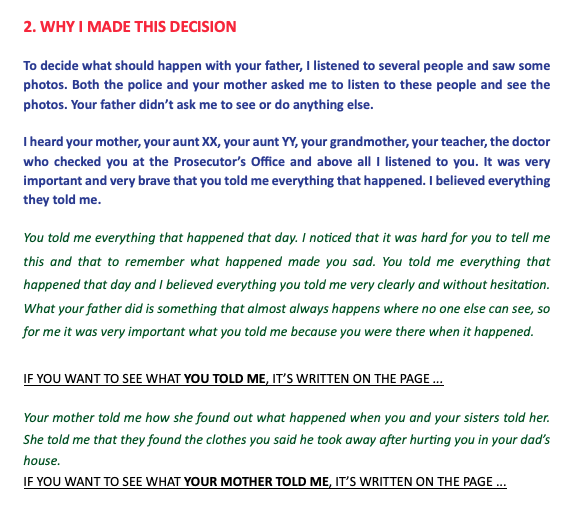
Considering the path of neurocognitive development, the didactic preface presents the segments of a judicial ruling in a more accessible order. It begins with the operative clauses, then presents the legal reasoning; the body of evidence; the antecedents; the claims and finally matters concerning admissibility. Each segment is presented in three levels. The first level is a very brief statement of the main ideas expressed. The second level is a descriptive paragraph of the contents of each segment. The third level is a pinpoint reference to the specific page on which a very particular element can be found within the contents of the original ruling.
A fragment of an example (from Oral Proceedings 184/2019, Morelos Judicial District, at Chihuahua, Mexico) may serve to clarify. The titles of each segment are in large font and all capital letters, the first level is in bold font, the second in italics and the third is underlined text.
The author’s full article in its original Spanish version is titled ‘Método para la elaboración de sentencias accesibles para las infancias y adolescencias: el prefacio didáctico’, published in Revista métodhos, 1(29), 29-61, and available at https://revista-metodhos.cdhcm.org.mx/index.php/metodhos/article/view/226