Students do not protest in a vacuum; they protest because the right to gather, speak, and dissent is part of democratic life. Under Article 19 and Article 21 of the International Covenant on Civil and Political Rights (ICCPR), everyone has the right to freedom of expression and freedom of peaceful assembly. Taken together, these rights give students the legal and democratic space to organize, speak out, and challenge injustice without fear of repression.
According to UNESCO’s Recommendation on the Status of Higher-Education Teaching Personnel, academic freedom is
the right, without constriction by prescribed doctrine, to freedom of teaching and discussion, freedom in carrying out research and disseminating and publishing the results thereof, freedom to express freely their opinion about the institution or system in which they work, freedom from institutional censorship and freedom to participate in professional or representative academic bodies.
Under the same UNESCO Recommendation, institutional autonomy refers to the level of self-governance higher education institutions need to make effective decisions about academic work, standards, administration, and related activities, while remaining publicly accountable and respecting academic freedom and human rights. In this sense, autonomy is the institutional expression of academic freedom and a necessary condition for universities and academic staff to carry out their functions properly.
As stated in the Magna Charta Universitatum, universities should be guided by the principle of independence: research and teaching must remain intellectually and morally free from political pressure and economic interests.
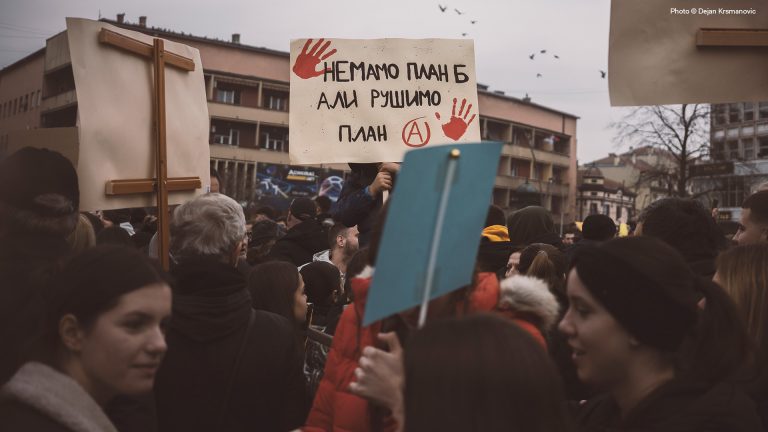
In Serbia, since the Novi Sad canopy collapse in November 2024, outrage over corruption and institutional neglect turned into large-scale student-led mobilization. Since late June 2025, over 200 demonstrations have occurred daily experiencing an escalation in policing of peaceful, student-led protests. What followed was not only a protest against one tragedy, but a wider struggle over accountability, civic space, and the autonomy of universities as places where free thought should be defended, not punished.
In Serbia, academic freedom is not being discussed in abstract terms. It is being tested through pressure on students, teachers, and universities, through intimidation, surveillance, arbitrary arrests, and smear campaigns, all of which point to a deeper erosion of the right to speak, assemble, teach, research, and participate freely in public life.
This is not only a question of protest but also a question of several rights at stake. Students are not acting outside the democratic order when they gather, speak, and challenge injustice; they are exercising their rights to participation, learn without fear, freedom of expression, and freedom of peaceful assembly and protest in relation to their academic environment, which are central to any rights-respecting society. A human rights-based approach to this context helps show that academic freedom is not an isolated principle to be addressed within a university, but part of a wider system of protection of fundamental rights. When these are unlawfully restricted, the problem is not only academic; it becomes democratic.
The current moment in Serbia is not only about a public safety failure, but also about the political consequences of mass mobilization and the changing relationship between state power and academic freedom.
To understand why the current protests in Serbia matter beyond a single policy dispute, it is useful to turn to social movement theory. Charles Tilly’s work on social movements and democratization highlights how collective action can reshape political life when people challenge existing power structures and expand the boundaries of democratic participation. Alain Touraine goes further by showing that social movements are not only responses to crises, but they can also become revolutionary forces when they contest the direction of society itself. Alberto Melucci adds another important dimension: movements are also struggles over meaning, identity, and visibility, especially in contexts where institutions try to control the public narrative.
The Velvet Revolution is often cited as a powerful example of how student and youth movements can help initiate democratic change. As the analysis by Libor Konvička and Jan Kavan shows, the mobilization of young people in 1989 was not a marginal side event, but a driving force in the broader political transformation of Czechoslovakia. Students helped turn public frustration into organised civic action, giving momentum to a movement that ultimately challenged authoritarian rule and opened the path to democratization. The importance of the Velvet Revolution lies precisely in this connection between youth activism and systemic change: what began as a protest movement became a catalyst for a new political order.
In Serbia, student mobilization has become the driving force of a broader democratic challenge. The students’ protest campaign has been smart, creative, leaderless, and transparent, and it is not aimed at replacing one politician or party with another, but at changing the system itself. This is significant because it shows how student activism can move beyond campus politics and become a national political force. At the same time, the University of Belgrade has emerged as a symbol of resistance.
Serbia’s ’rebel university’ has emerged as an academic coalition now standing at the front line against state repression, suggesting that the struggle is no longer only about protest outside the university, but also about protecting the autonomy of the university itself. Together, these developments reveal how student movements can turn tragedy into sustained civic mobilization and how academic institutions can become central to democratic contestation.
The investigation of the recent tragic death of a student at University of Belgrade has been heavily politicized: government officials and pro-government tabloids launched a ’bloody hands’ smear campaign against the Rector Vladan Đokić and the Dean Danijel Sinani in order to discredit their support for the student-led protest movement, while also instrumentalizing this tragedy as a pretext for the state to weaken university autonomy, with the Ministry of Education using allegations of ’negligence’ to justify greater control over faculty governance.
‘When a government sends police to a university, it means it has lost all arguments’, the Rector Vladan Đokić emphasised in the campus of the University of Belgrade. He has insisted that the university must remain an autonomous space protected from political interference, stressing that academic freedom is inseparable from the institution’s right to govern itself and pursue knowledge without coercion. That principle is now under growing pressure. Although recent reforms to higher education in Serbia are presented as modernization measures on paper, there is a gap between formal policy language and actual practice, raising questions about how far institutional independence is genuinely protected.
Way forward
The question that now emerges is whether university autonomy and academic freedom can once again become catalysts for broader democratic renewal in Europe. History has shown that when students, academics, and universities are prevented from teaching, researching, and expressing critical views freely, the resulting suppression can do more than silence dissent: it can intensify it.
Academic freedom, understood from a human rights-based perspective, is closely linked to the freedoms that make critical inquiry possible, including freedom of expression, access to information, and institutional autonomy. When these conditions are restricted, censored, or politicized, the consequences often extend far beyond the campus.
They can fuel frustration, solidarity, and mass mobilization, especially among young people who see the university as one of the last spaces where democratic values are still defended. In that sense, Serbia’s case reminds us that attacks on academic freedom are never only institutional disputes; they are also warnings about the future of democracy itself.