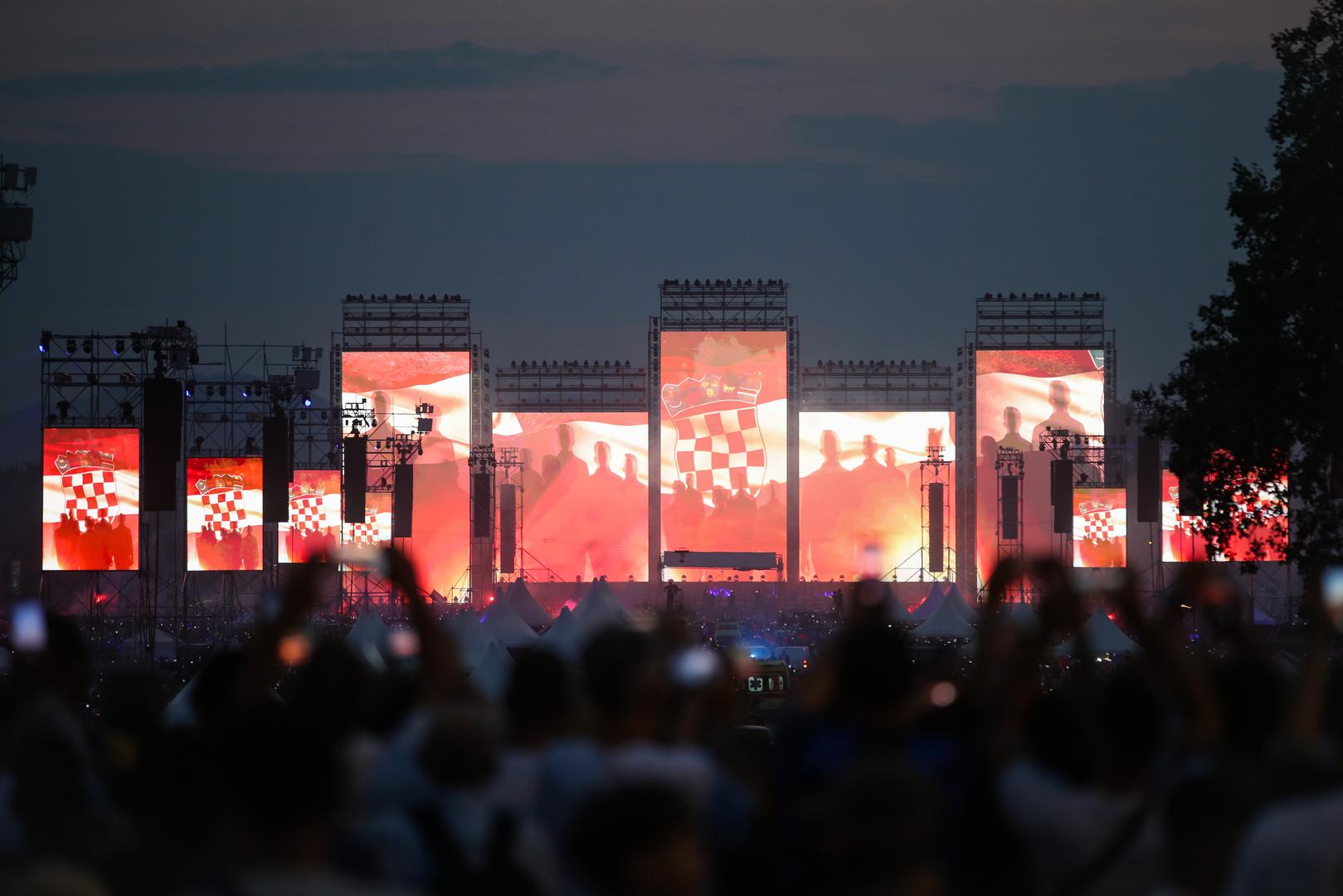
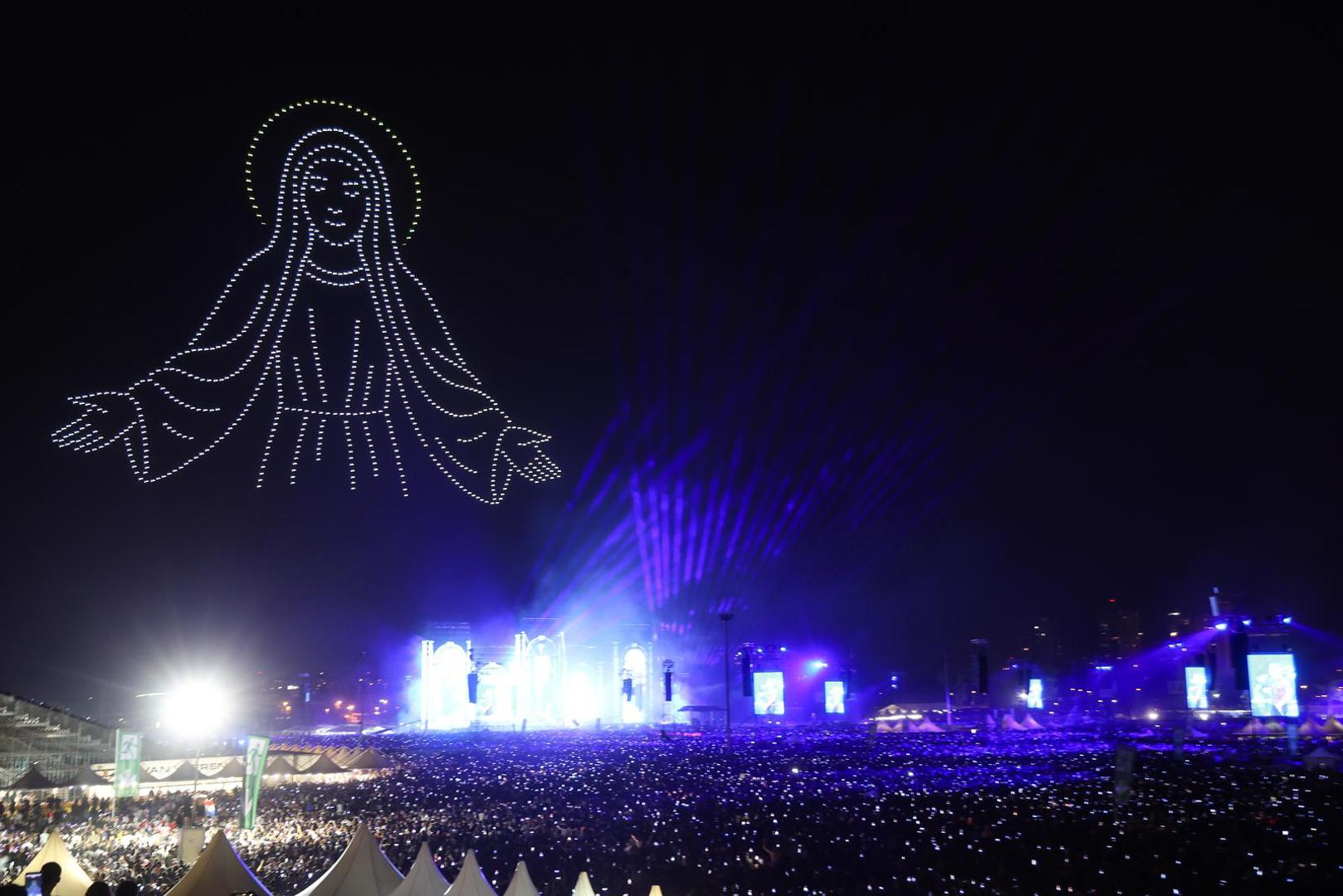
When over half a million people attended Marko Perković Thompson’s concert at Zagreb’s Hippodrome in July 2025, Croatia witnessed not only a major live performance, but for some it was a spectacular expression of popular culture and patriotic feeling, for others a display of nationalism repackaged, normalised and sold back to the public in the form of entertainment.
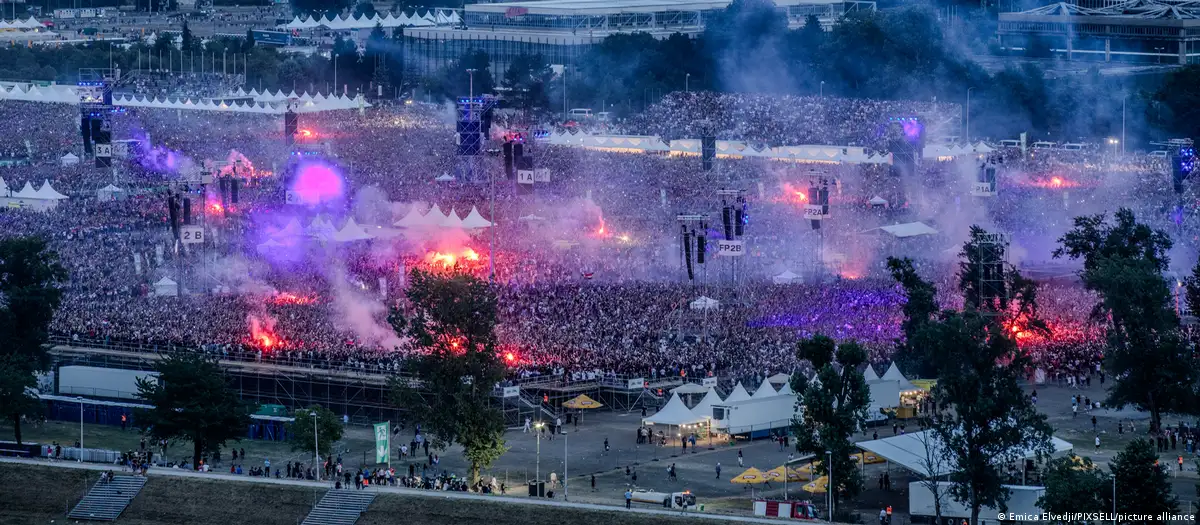
Then came a concert in Sinj, held on the 30th anniversary of ‘Oluja’ military action and attended by 150,000 people, which confirmed that Zagreb was not a one-night anomaly but proof of scale, repetition and momentum.
This is the ‘Thompson effect’ – not just the success of a singer, but the power of one figure to gather huge audiences around a charged mixture of patriotism, war memories, religious symbolism and national identity.
It’s not about music – it’s about Croatia
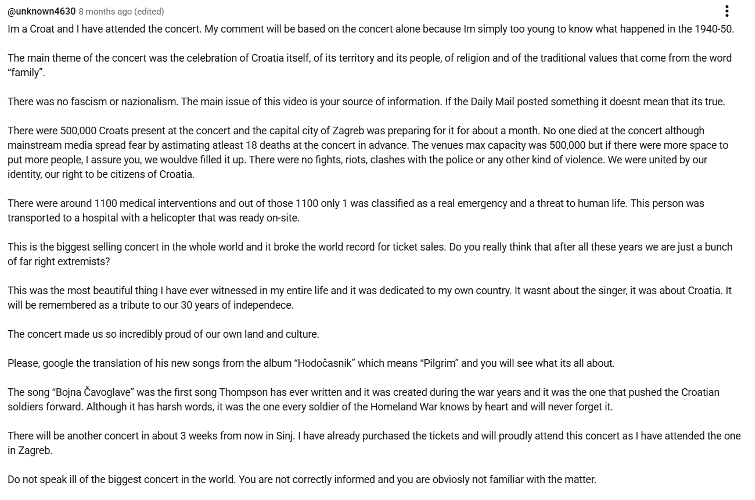
The main theme of the concert was the celebration of Croatia itself, of its territory and its people, of religion and of the traditional values that come from the word “family” …. This was the most beautiful thing I have ever witnessed in my entire life and it was dedicated to my own country. It wasn’t about the singer; it was about Croatia.
Anonymous comment from a Zagreb concert attendee, left on the Youtube video ‘Can Croatia Confront Its Fascist Past?’
What makes Thompson’s work controversial is the emotional world that has been constructed around him, overlaid with symbols, slogans and narratives that are politically charged to say the least. The problem is not whether you can sing about your homeland – of course you can – but whether nationalism is being disguised as popular culture until it no longer resembles ideology but atmosphere.
In the case of the Hippodrome concert, the audience was not simply attending a concert but participating in a ritual in which emotions were amplified and history simplified, making the political meaning behind it somehow more palatable, precisely because it is presented in song.
Thus, Thompson offers not only music but permission to believe that nationalism is desirable, to treat historical ambiguity as cultural pride and to condemn anyone who criticises him as elitist and anti-Croatian.
Divided Croatia
Not all Croats feel the same about Thompson’s work. For some, he represents legitimate patriotism, for others, something much more worrying: the normalisation of exclusionary politics under the guise of culture.
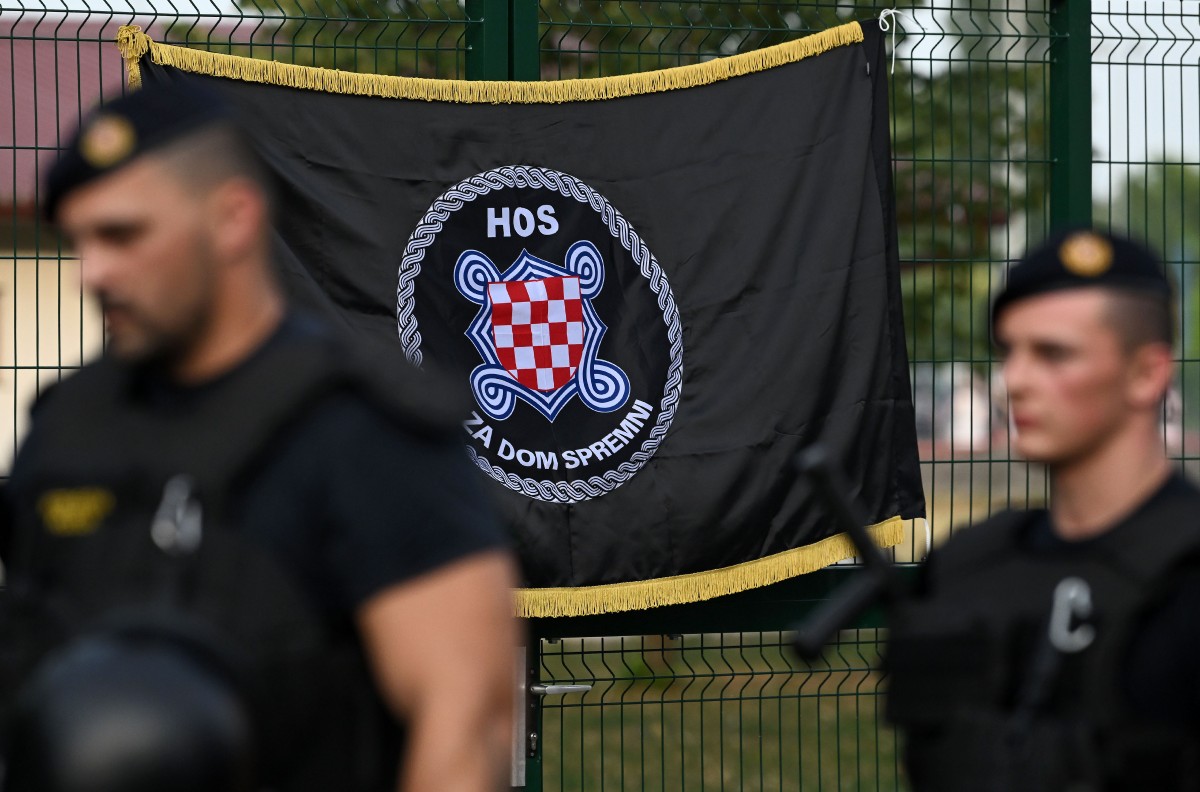
Croatia has spent years pretending that Thompson is simply a musician who provokes strong feelings. Although several EU countries (Slovenia, Germany, the Netherlands) forbid Thompson’s concerts on multiple occasions due to its promotion of the Ustasha regime through the ‘Za dom spremni’ salute, for a big portion of the Croatian lawmakers he is still a promoter of patriotism and traditional values.
The Croatian High Misdemeanour Court has allowed use of this phrase in his songs, saying that it does not violate public order laws in this specific musical context but serves to commemorate the 1990s war rather than an incitement to hate speech and connection to World War Two. However, use of the salute by the crowd is more complex.
Conversely, the salute is banned by the Croatian Constitutional Court and police have punished its use on multiple occasions. Yet at the Zagreb concert, where half a million people responded with ‘Spremni!’ (‘Ready’) to his ‘Za dom’ (‘For the Homeland’)’, the government and some courts have avoided penalising the crowd. Thus, inconsistency in legal treatment of the salute is adding further fuel to the already heated debate.
Artistic freedom is not freedom from judgement
The main argument used by Thompson’s defenders is artistic freedom. It is true that democracies do not become stronger by censoring controversial figures simply because they offend large sections of society. Artistic freedom includes scope to provoke, disturb, irritate and polarise but it does not mean total freedom from judgement.
It is perfectly possible to believe in the artist’s right to perform and also question what exactly is being normalised in the performance, to reject censorship and also reject euphemism. Democracy can defend artistic expression and at the same time insist that symbols carry meaning, slogans carry history and mass spectacles carry consequences.
One can call out the intellectual dishonesty in the argument for Thompson. His defenders present his right to perform and express patriotic feelings as if that should be the end of the discussion instead of merely the beginning. When an artist repeatedly works in a world of symbols shaped by militarised masculinity, wartime mythology, ethnic exclusivity and historical revisionism, then criticism is not censorship but civil obligation.
Neo-nationalism rarely arrives wearing a uniform
Neo-nationalism takes a softer shape than its forerunner, emotionally appealing to the people without revealing its true intentions.
It doesn’t have marks of extremist revisionist ideology: instead, it hides behind selective memory to present itself as an acceptable identity of which one can be proud.
Modern neo-nationalism rarely initially emerges through party manifestos or street movements but more frequently through culture, art, songs, festivals and public participation with symbols that make old politics feel familiar and comforting. By the time people say ‘it’s only music’, the cultural foundation has already been set.
This is what Thompson’s Zagreb concert demonstrates. It would be lazy and untrue to assume that every person attending was an extremist. Some came for the music, some for the atmosphere and social energy, others because their friends were going. But the sheer scale of it gives legitimacy to the symbolism presented which changes what society is willing to tolerate.
Once something is performed by hundreds of thousands, it becomes easier to call it normal and harder to challenge. Once emotionally embedded, it becomes politically useful. That is how neo-nationalism grows.
Croatia must stop hiding behind ambiguity
What Croatia needs in relation to Thompson is not moral panic but moral clarity. It must acknowledge that patriotism can indeed be legitimate but that not all patriotism is legitimate, that artistic freedom is undeniable as long it doesn’t shield historical amnesia and that culture can never be politically neutral, especially when it involves use of symbols rooted in tragic history.
Thompson doesn’t simply reflect the mood, he amplifies it, legitimises it, makes it spectacular. He takes nationalism and turns it into a fun experience.
Ultimately, the debate here is not about one man or one singer. Thompson is a symbol of a bigger issue – the ambivalent relationship Croatia still has with nationalism, history and public identity. And it is about the time to stop pretending that ambiguity equals neutrality, and confront its history more honestly. It’s a long-term process and it should start first with those who influence public opinion more strongly, such as academics, political leaders and other influential public figures, who need to take a clear stand not only on Thompson, but on the broader normalisation of revisionism, compromised symbols and selective memory in public life.
The questions are no longer about whether Thompson is divisive or if his salute has the same meaning as the one used by the Ustasha regime. Undoubtedly he is and it does, but what does his success say about the country that keeps making room for him?
Zagreb was not just a concert, it was a signal and although some heard it loud and clear, many still continue to pretend it’s not there.
This week we are delighted to publish a new post by Marko Matović, the blog’s regional correspondent for South East Europe. His previous posts are available here and here.
The GCHRP Editorial Team